






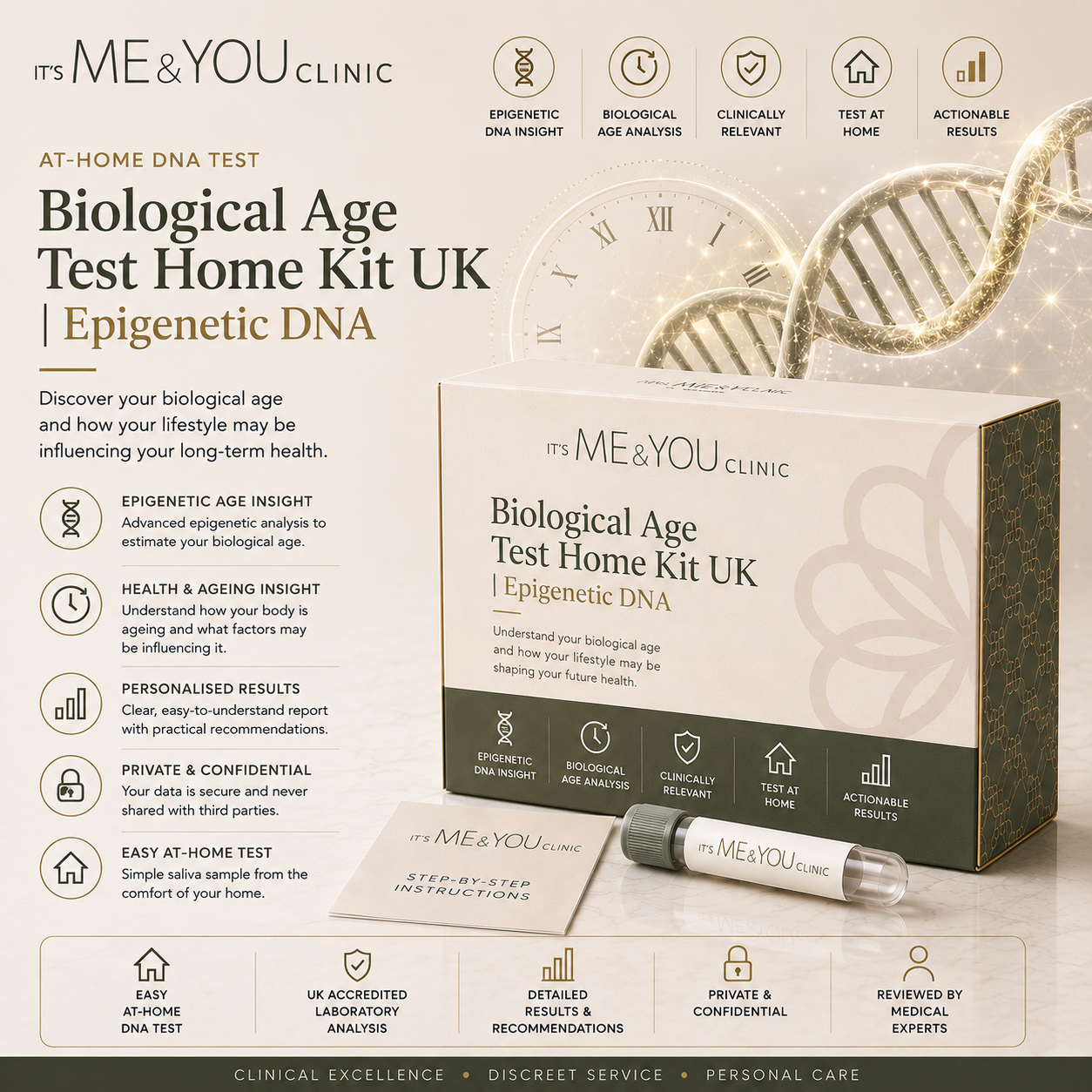



Saliva epigenetic test home kit UK
Biological Age Test Home Kit UK
A saliva based epigenetic test that estimates biological age from DNA methylation patterns using the laboratory’s stated clock and analytical method.
What this product is designed to clarify: Biological age is often marketed as a definitive score. This page instead treats it as a method dependent wellness estimate whose meaning depends on the clock, sample type, reference population, quality controls and uncertainty stated in the report.
When the product may be useful
Begin with the reason for testing
- Establishing a personal baseline using one defined epigenetic method
- Comparing a later result using the same laboratory and clock
- People who understand that the result is not a diagnosis or lifespan prediction
- People who have reviewed the privacy, retention and consent terms
- Diagnosing or excluding disease
- Predicting lifespan or a date of death
- Proving that a supplement, diet or treatment caused the result
- Testing without understanding how genetic and inferred health data will be handled
The report at a glance
What is measured and what remains outside the kit
The estimate is not the person
What biological age can and cannot tell you
Method transparency
Why two laboratories may report different ages
Reading the report
Younger, similar and older estimates
The colours describe the direction of the comparison, not health, disease or lifespan.
The algorithm estimates an epigenetic age below chronological age for the saliva sample.
Treat this as a comparative wellness estimate, not proof of freedom from disease or extended lifespan.The estimate is close to chronological age within the laboratory's expected range or uncertainty.
Use the methodology and uncertainty stated in the report before drawing conclusions.The algorithm estimates an epigenetic age above chronological age.
This is not a diagnosis. Review established health risks with a clinician rather than attempting unproven anti ageing treatment.The result may be affected by sample quality, cell composition, assay platform, batch effects or use of a clock not optimised for saliva.
Check the laboratory quality note and consider repeat testing only under comparable conditions.The sample or algorithm did not produce a result that meets the laboratory's quality criteria.
Do not infer health status. Follow the provider's recollection or repeat testing instructions.Data is part of product quality
Questions the privacy policy should answer
Preparation and collection quality
Before taking the sample
- Read the consent, privacy, retention and deletion terms before opening the kit
- Avoid food, drink, smoking, vaping, gum and oral products for the stated collection interval
- Do not add water or another liquid unless the supplier instructs you to do so
- Collect the required saliva volume and close the tube exactly as directed
- Use the same collection conditions if you later repeat the test
Small preparation details can change interpretation
Laboratory methods, sample stability and collection devices vary. An insufficient, delayed, contaminated or incorrectly labelled sample may not be suitable for analysis.
From selection to secure report
How this home testing pathway works
Review the method
Read which epigenetic clock, platform, sample type and uncertainty the service intends to report.
Consent deliberately
Review the lawful basis, special category data terms, storage location and retention period.
Prepare the mouth
Follow the restricted period for food, drink, smoking, gum and oral care.
Collect saliva
Provide the required volume without adding unapproved liquid.
Return securely
Use the supplied packaging and tracking instructions.
Read the estimate
Interpret the score with the clock, uncertainty and quality notes rather than as a diagnosis.
Fact checked and medically reviewed
Clinical and editorial oversight
This page was rebuilt from the supplied laboratory specification and checked against the UK medical, regulatory and professional sources listed below. Medical review is attributed to Veronika Matutyte, Dr Rimas Geiga, Dr Laura Geige. The wider clinic advisory network is shown in compact form.
 Dr Laura GeigeMedical Director, Senior Practitioner and Skin Expert Page reviewer
 Dr Giedre NarkieneMedical Doctor, Board Certified Dermatologist and Advisory Board Member Advisory contributor
 Veronika MatutyteMedical Doctor, Healthcare Management Expert and Advisory Board Member Page reviewer
 Dr Snieguole GeigeAesthetic Dentist, Medical Doctor and Advisory Board Member Advisory contributor
 Dr Rimas GeigaMedical Doctor, Nutritional Sciences Adviser and Advisory Board Member Page reviewer
It’s Me & You Clinic in Kingston upon Thames
Local continuity for private laboratory results
It’s Me & You Clinic provides a discreet Kingston setting for healthy ageing discussions that remain grounded in established risk factors rather than treating one molecular estimate as a medical verdict.
Clinic details
Office 7, Siddeley House, 50 Canbury Park Road
Kingston upon Thames KT2 6LX
Questions people ask before ordering
Concise answers without heavy FAQ cards
Is a biological age test the same as a genetic risk test?
No. This product estimates age related methylation patterns. It does not provide a complete inherited disease risk analysis.
Does the test sequence my whole genome?
The supplier material describes an epigenetic methylation analysis rather than whole genome sequencing. The exact platform and clock should be identified in the laboratory report.
Can two biological age tests give different answers?
Yes. Different clocks, sample types, platforms and reference populations can produce different estimates.
What does an older estimate mean?
It means the algorithm estimated an epigenetic age above chronological age for that sample. It is not a diagnosis or a prediction of lifespan.
Why is privacy especially important?
DNA and inferred health information are sensitive and persistent. Review consent, storage, transfer, retention and deletion terms before testing.
UK medical, professional and laboratory references
Sources used for this page
- Horvath: DNA methylation age of human tissues and cell types
- Comparison of 14 epigenetic clocks and incident disease outcomes
- DNA methylation age differences between array platforms and sample types
- Saliva DNA methylation age prediction study
- Longitudinal changes in epigenetic clocks and survival research
- NHS Genomics Education: what is epigenetics?
- ICO special category data guidance
- ICO guidance on genomic data
- UKAS medical laboratory accreditation
- CQC diagnostic and screening services guidance
Home testing provides laboratory information, not a diagnosis or personal treatment plan. Do not delay urgent care while waiting for a kit or result. Call 999 for a medical emergency. Use NHS 111 or an appropriate clinician for urgent concerns that are not immediately life threatening. Do not start, stop or alter prescribed treatment solely because of a home result.