






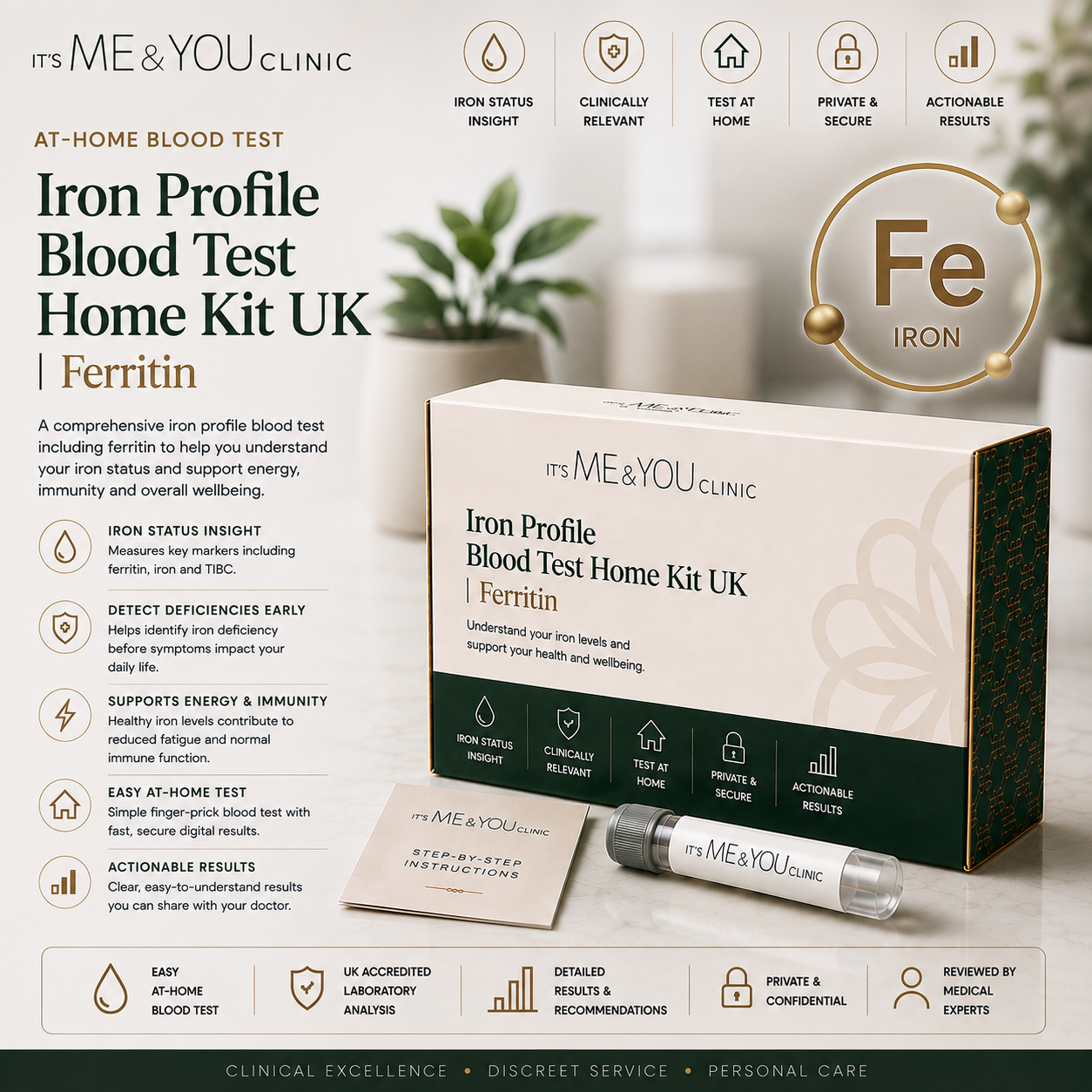



Blood test home kit UK
Iron Profile Blood Test Home Kit UK
A five marker iron profile showing storage, circulation, transport capacity and saturation in one report.
Ferritin is central but not infallible. Inflammation can raise ferritin, while serum iron changes with meals, time and supplements. The complete pattern is more informative than any one iron result.
When it may be considered
Start with symptoms, risk and the reason for testing
- Persistent tiredness or reduced exercise tolerance
- Heavy menstrual bleeding or another source of blood loss
- Frequent blood donation
- A restrictive diet or malabsorption risk
- A family history of hereditary haemochromatosis
- Confirming anaemia without a full blood count
- Taking iron without investigating the cause
- Ignoring possible bleeding, black stools or severe breathlessness
The report at a glance
How the included markers fit together
Iron is stored, carried and bound
Why five markers are more useful than serum iron alone
The relationship between markers
Common iron profile patterns
Five marker detail
Colour coded results and next steps
Transferrin saturation
Transferrin saturation, often shortened to TSAT, estimates the percentage of iron binding sites on transferrin that are occupied. It is calculated from serum iron and TIBC.
May occur with iron deficiency, chronic blood loss, poor absorption, inflammation or increased iron requirements.
Discuss the complete pattern with a GP. A full blood count may also be required.Falls within the laboratory interval.
Interpret with ferritin and the other iron studies.May occur after supplementation, iron treatment, transfusion, hereditary haemochromatosis, liver disease or other causes.
Discuss a persistent or unexplained result with a clinician.A very high or rapidly rising result may require prompt assessment, especially with a raised ferritin or liver abnormalities.
Follow the laboratory's urgent advice.Ferritin
Ferritin is the principal laboratory marker used to estimate stored iron. A low result strongly supports depleted iron stores.
A very low result indicates markedly depleted iron stores and may coexist with significant anaemia or ongoing blood loss.
Arrange prompt GP assessment and a full blood count.NICE guidance states that ferritin below 30 micrograms per litre confirms iron deficiency in adults.
Discuss the cause, including bleeding, diet, donation and malabsorption, with a clinician.Falls within the reference interval.
Consider symptoms, inflammation, TSAT and a full blood count where available.May occur with inflammation, infection, liver disease, alcohol use, metabolic conditions, iron overload, malignancy or supplementation.
Do not assume haemochromatosis from ferritin alone. Discuss the complete pattern.A markedly raised result may require urgent assessment depending on symptoms, liver tests and the laboratory threshold.
Follow the report's escalation advice.Serum iron
Serum iron measures iron circulating in the blood at the time of collection. Iron is needed to produce haemoglobin, but the serum result changes with meals, time of day, supplements and illness.
May occur with iron deficiency, inflammation, chronic illness, blood loss or poor absorption.
Interpret with ferritin, transferrin, TIBC, TSAT and a full blood count.Falls within the laboratory interval.
A normal serum iron result does not exclude depleted iron stores.May reflect recent supplements, iron treatment, transfusion, haemolysis, liver disease or iron overload.
Discuss an unexpected result with a clinician.Very A raised circulating iron value can be seen with overdose or acute iron toxicity.
Seek immediate medical advice where overdose is possible.Transferrin
Transferrin is produced mainly by the liver and transports iron through the blood. The concentration often increases when the body is trying to capture more iron.
May occur with inflammation, liver disease, poor nutrition, kidney protein loss or iron overload.
Interpret with ferritin, serum iron and TSAT.Falls within the laboratory reference interval.
Review it as part of the full iron profile.Often occurs when iron stores are depleted and may also be influenced by pregnancy or oestrogen containing treatment.
Discuss the result if ferritin or TSAT is also low.Total iron binding capacity
Total iron binding capacity, known as TIBC, estimates the total amount of iron that blood proteins could bind. It mainly reflects transferrin.
May occur with inflammation, liver disease, poor nutrition, kidney disease or iron overload.
Interpret with ferritin, serum iron, transferrin and TSAT.Falls within the laboratory reference interval.
A normal TIBC does not by itself establish that iron status is normal.Commonly occurs when iron stores are depleted and may also be influenced by pregnancy or oestrogen treatment.
Discuss the complete profile with a GP if ferritin or TSAT is low.Low results need a cause
Heavy menstrual bleeding, gastrointestinal blood loss, diet, donation and malabsorption are among the possible considerations. Supplements alone do not explain why stores became low.
Inflammation, liver factors, supplements and hereditary iron overload can create different raised patterns.
Preparation protects the value of the result
Before collecting the sample
- Follow the fasting period stated in the kit
- Collect in the morning where instructed
- Record iron tablets, infusions and multivitamins
- Avoid changing supplements solely to influence the result
Collection requirements can vary with the laboratory method, sample stability and clinical purpose. An insufficient, contaminated, delayed or incorrectly labelled sample may not be suitable for analysis.
From order to secure report
How the home testing pathway works
Choose the right question
Review the exact markers, collection method and limitations before ordering.
Receive and register
Use the supplied registration details so the sample is matched to the correct person.
Prepare consistently
Follow timing, fasting, medicine, supplement and activity guidance specific to this test.
Collect at home
Collect the morning fasting finger prick capillary blood sample exactly as instructed.
Return promptly
Use the supplied return materials within the stated stability window.
View results securely
The report is released through the relevant secure digital pathway after quality checks.
Fact checked and medically reviewed
Clinical and editorial oversight
This page was rebuilt from the supplied laboratory specification and checked against the UK medical, regulatory and professional sources listed below. Medical review is attributed to Dr Rimas Geiga, Veronika Matutyte, Dr Laura Geige. The wider clinic advisory network is shown in compact form.
 Dr Laura GeigeMedical Director, Senior Practitioner and Skin ExpertPage reviewer
 Dr Giedre NarkieneMedical Doctor, Board Certified Dermatologist and Advisory Board MemberAdvisory contributor
 Veronika MatutyteMedical Doctor, Healthcare Management Expert and Advisory Board MemberPage reviewer
 Dr Snieguole GeigeAesthetic Dentist, Medical Doctor and Advisory Board MemberAdvisory contributor
 Dr Rimas GeigaMedical Doctor, Nutritional Sciences Adviser and Advisory Board MemberPage reviewer
It’s Me & You Clinic in Kingston upon Thames
Doctor led interpretation with local continuity
The Kingston clinic can help place an iron pattern within symptoms, menstrual history, diet, supplements and wider medical assessment. A low result should lead to investigation of cause, not supplementation alone.
Find us
Office 7, Siddeley House, 50 Canbury Park Road
Kingston upon Thames KT2 6LX
Common questions
Clear answers without oversized FAQ cards
What is the difference between ferritin and serum iron?
Ferritin estimates stored iron. Serum iron is a more variable measure of iron circulating at the time of collection.
Does this test diagnose iron deficiency anaemia?
No. A full blood count is needed to assess haemoglobin and red blood cell indices.
What is transferrin saturation?
It estimates the proportion of transferrin binding sites occupied by iron.
Why is fasting morning collection recommended?
Serum iron changes with meals and time of day. Standardised collection improves comparability.
Can high iron results matter?
Yes. Raised ferritin or saturation can require repeat testing and assessment for inflammation, liver factors, supplements or iron overload.
UK medical and laboratory references
Sources used for this page
- NICE iron deficiency investigations
- NHS TIBC and transferrin test information
- NHS iron deficiency anaemia information
- NHS haemochromatosis diagnosis
- Sheffield Laboratory Medicine iron profile information
- NHS iron, transferrin and transferrin saturation information
- UKAS medical laboratory accreditation
- CQC diagnostic and screening services guidance
This page provides general information about selected laboratory markers. It does not provide a diagnosis or personal treatment recommendation. Do not delay care while waiting for a kit or result. Call 999 for a medical emergency. Use NHS 111 or an appropriate clinician for urgent concerns that are not immediately life threatening. Do not change prescribed treatment solely because of a home result.