






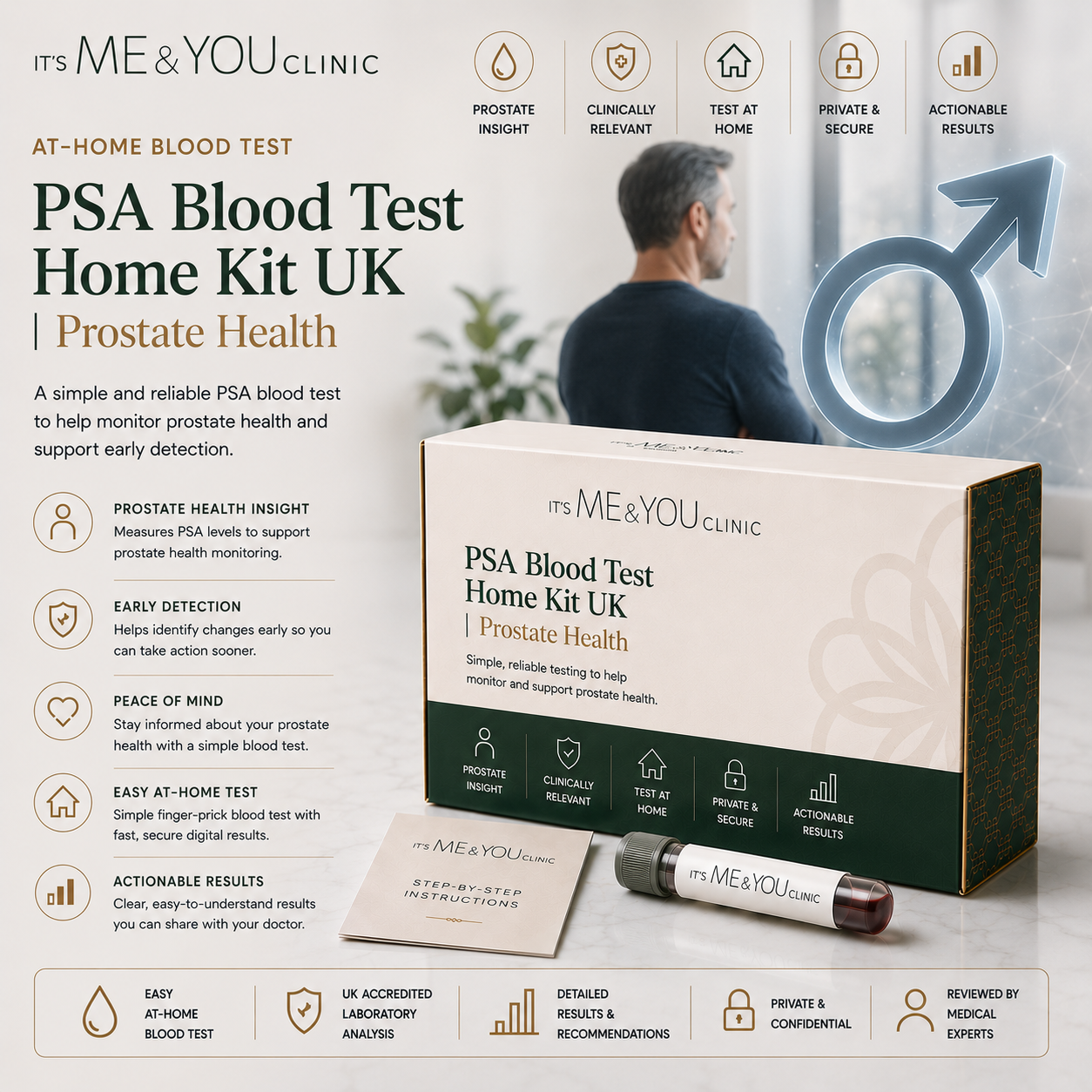



Blood test home kit UK
PSA Blood Test Home Kit UK
A total prostate specific antigen test with preparation and follow up guidance placed ahead of the number.
PSA is a prostate marker, not a cancer diagnosis. Benign enlargement, inflammation, infection, ejaculation, cycling and procedures can all influence the result, while a low value cannot exclude every prostate cancer.
When it may be considered
Start with symptoms, risk and the reason for testing
- Discussing prostate health with a GP
- Urinary symptoms or a new erectile problem
- Men over 50 considering benefits and limitations
- Black men or men with close family history discussing testing from 45
- Monitoring requested after a prostate diagnosis or treatment
- Using PSA to diagnose or exclude prostate cancer alone
- Testing during a urinary infection
- Ignoring persistent symptoms because the result is low
The report at a glance
How the included markers fit together
Decide before you test
Potential value and important limitations
Preparation can alter the number
Reduce avoidable temporary influences
Age, risk and history matter
PSA reporting categories
PSA is normally detectable in people with a prostate. The value must be interpreted in ng/mL using the laboratory interval, age, symptoms, previous results and medicines.
Share the numerical result with a GP rather than interpreting the word detected as abnormal.A result below the assay detection limit may occur naturally or after prostate treatment. Medicines such as finasteride or dutasteride may also lower PSA.
An undetected result does not exclude every prostate condition. Post treatment results must be reviewed by the treating team.A low PSA is generally less concerning than a raised value, but it is not a guarantee that prostate cancer is absent.
See a GP if symptoms, a prostate abnormality, family history or another risk factor is present.The value falls within the reporting laboratory or age related comparison range.
A result described as normal does not override concerning symptoms or a significant change from your previous PSA.A raised result can occur with prostate cancer, benign enlargement, prostatitis, urine infection, ejaculation, cycling, vigorous exercise or recent prostate procedures.
Arrange GP review. Repeat testing, infection assessment, MRI or specialist referral may be considered.A meaningful increase over time may be important even when the result remains within a broad laboratory interval.
Provide previous PSA results and collection dates to the clinician assessing you.PSA itself rarely creates an emergency, but urinary retention, heavy bleeding, sepsis symptoms or possible spinal cord compression require immediate assessment.
Use urgent NHS services or call 999 for severe or rapidly progressive symptoms.A raised result is the beginning of a pathway
What may happen next
Preparation protects the value of the result
Before collecting the sample
- Avoid ejaculation for the stated period
- Avoid vigorous cycling and similar activity
- Do not collect during a urinary infection
- Record recent prostate procedures and previous PSA values
Collection requirements can vary with the laboratory method, sample stability and clinical purpose. An insufficient, contaminated, delayed or incorrectly labelled sample may not be suitable for analysis.
From order to secure report
How the home testing pathway works
Choose the right question
Review the exact markers, collection method and limitations before ordering.
Receive and register
Use the supplied registration details so the sample is matched to the correct person.
Prepare consistently
Follow timing, fasting, medicine, supplement and activity guidance specific to this test.
Collect at home
Collect the finger prick capillary blood sample exactly as instructed.
Return promptly
Use the supplied return materials within the stated stability window.
View results securely
The report is released through the relevant secure digital pathway after quality checks.
Fact checked and medically reviewed
Clinical and editorial oversight
This page was rebuilt from the supplied laboratory specification and checked against the UK medical, regulatory and professional sources listed below. Medical review is attributed to Dr Rimas Geiga, Dr Snieguole Geige, Dr Laura Geige. The wider clinic advisory network is shown in compact form.
 Dr Laura GeigeMedical Director, Senior Practitioner and Skin ExpertPage reviewer
 Dr Giedre NarkieneMedical Doctor, Board Certified Dermatologist and Advisory Board MemberAdvisory contributor
 Veronika MatutyteMedical Doctor, Healthcare Management Expert and Advisory Board MemberAdvisory contributor
 Dr Snieguole GeigeAesthetic Dentist, Medical Doctor and Advisory Board MemberPage reviewer
 Dr Rimas GeigaMedical Doctor, Nutritional Sciences Adviser and Advisory Board MemberPage reviewer
It’s Me & You Clinic in Kingston upon Thames
Doctor led interpretation with local continuity
The clinic is around five minutes from Kingston railway station. PSA decisions can be discussed privately, but urinary retention, fever with urinary symptoms or severe pain requires prompt medical care.
Find us
Office 7, Siddeley House, 50 Canbury Park Road
Kingston upon Thames KT2 6LX
Common questions
Clear answers without oversized FAQ cards
Is PSA a prostate cancer test?
It is a prostate marker that may be raised in cancer, but benign enlargement, inflammation and infection can also raise it.
Can a low PSA rule out prostate cancer?
No. A lower result reduces some concern but cannot exclude every cancer or replace assessment of symptoms.
Should I avoid ejaculation before testing?
Follow the supplier preparation period because ejaculation can temporarily influence PSA.
Should I avoid cycling?
The supplier guidance advises avoiding vigorous cycling and similar activity before collection.
What happens after a raised PSA?
A GP may consider repeat testing, examination, risk assessment, imaging or referral depending on the whole picture.
UK medical and laboratory references
Sources used for this page
- NHS PSA test guidance
- NHS prostate cancer symptoms and diagnostic information
- NICE prostate cancer assessment and age specific PSA context
- Prostate Cancer UK guide to the PSA blood test
- Prostate Cancer UK diagnostic pathway after a raised PSA
- Prostate Cancer UK discussion of home PSA test benefits and risks
- UKAS medical laboratory accreditation
- CQC diagnostic and screening services guidance
This page provides general information about selected laboratory markers. It does not provide a diagnosis or personal treatment recommendation. Do not delay care while waiting for a kit or result. Call 999 for a medical emergency. Use NHS 111 or an appropriate clinician for urgent concerns that are not immediately life threatening. Do not change prescribed treatment solely because of a home result.