




Doctor led menopause related testing from Kingston
Menopause and Perimenopause Blood Tests UK
A clinically responsible collection of female hormone, thyroid and vitamin D home blood tests for selected menopause and perimenopause related questions.
For most otherwise healthy people aged 45 or over with typical symptoms and menstrual changes, menopause is identified from the clinical history rather than routine hormone testing. Blood tests may still be relevant when symptoms are atypical, menopause is suspected earlier, another condition such as thyroid disease needs consideration or a clinician recommends targeted monitoring.

Start with age, symptoms and bleeding pattern
Menopause is often a clinical diagnosis rather than a laboratory result
The source collection correctly places clinical assessment before testing. In people aged 45 or over with typical symptoms, routine FSH, oestradiol or other ovarian hormone testing is generally not needed to identify perimenopause or menopause.
Testing becomes more relevant when symptoms begin earlier, the presentation is atypical, pregnancy remains possible, thyroid disease or another condition needs consideration, or a clinician has a defined monitoring question.
Usually identified clinically
Typical symptoms at age 45 or over
Cycle change, hot flushes, night sweats, sleep disruption, mood change, vaginal or urinary symptoms and other typical features are interpreted with age and menstrual history. A fluctuating hormone result may add confusion rather than clarity.
Home testing should not delay discussion of symptom control, contraception, bone health, cardiovascular risk or treatment preferences.
Selected FSH testing may be considered when symptoms and menstrual change raise an early menopause question.
Suspected premature ovarian insufficiency requires clinician led assessment rather than one isolated home result.
Tiredness, palpitations, temperature sensitivity, bowel change and weight change may justify focused thyroid testing.
HRT and hormonal contraception may alter bleeding patterns and hormone results. Do not stop treatment to obtain a home result.
Bleeding after menopause, very heavy bleeding, severe pelvic pain, chest pain, marked breathlessness, one sided leg swelling, severe headache, visual disturbance, fainting or possible pregnancy should not be managed through a home hormone test alone.
Choose a test only when it answers a defined question
Different panels address different possibilities
A female hormone panel provides selected reproductive and androgen context. A thyroid panel addresses a different endocrine pathway. Vitamin D testing provides one part of bone health context. None of these tests can determine treatment suitability or replace assessment of symptoms and risks.


It’s Me & You Clinic collection
Menopause and perimenopause related home blood tests
These four product routes preserve the intended scope of the supplied collection while using It’s Me & You Clinic links, imagery and completely rewritten clinical guidance.

LH, FSH and androgen context
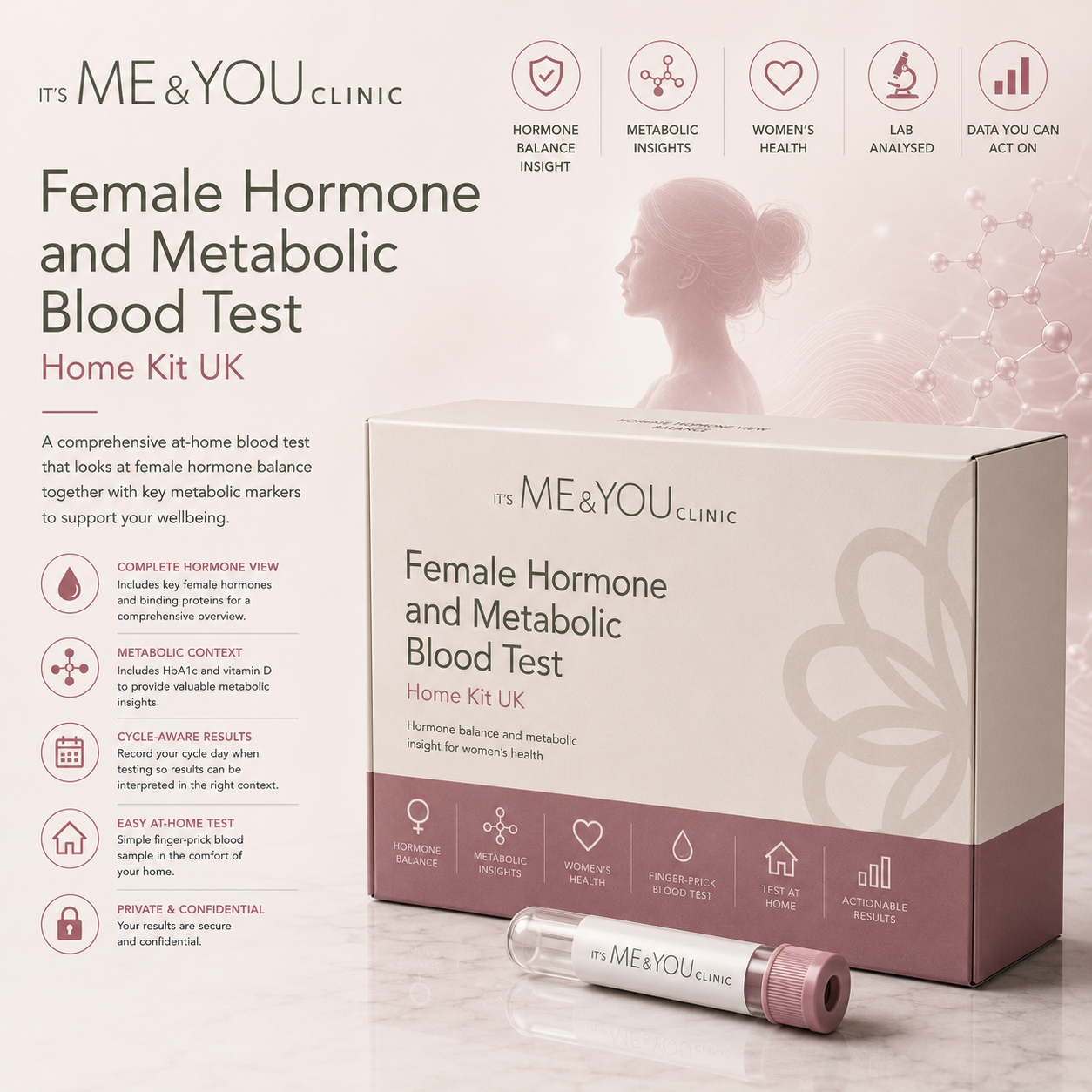
Female Hormone Blood Test Home Kit UK
A reproductive hormone panel for selected questions involving LH, FSH, testosterone, SHBG and calculated free androgen index.
- Focus
- LH, FSH, testosterone, SHBG and calculated free androgen index
- May be relevant when
- A clinically directed reproductive hormone question, particularly before age 45 or where the presentation is atypical
- Important limit
- Does not diagnose menopause, PCOS, infertility or HRT suitability by itself

Focused thyroid function
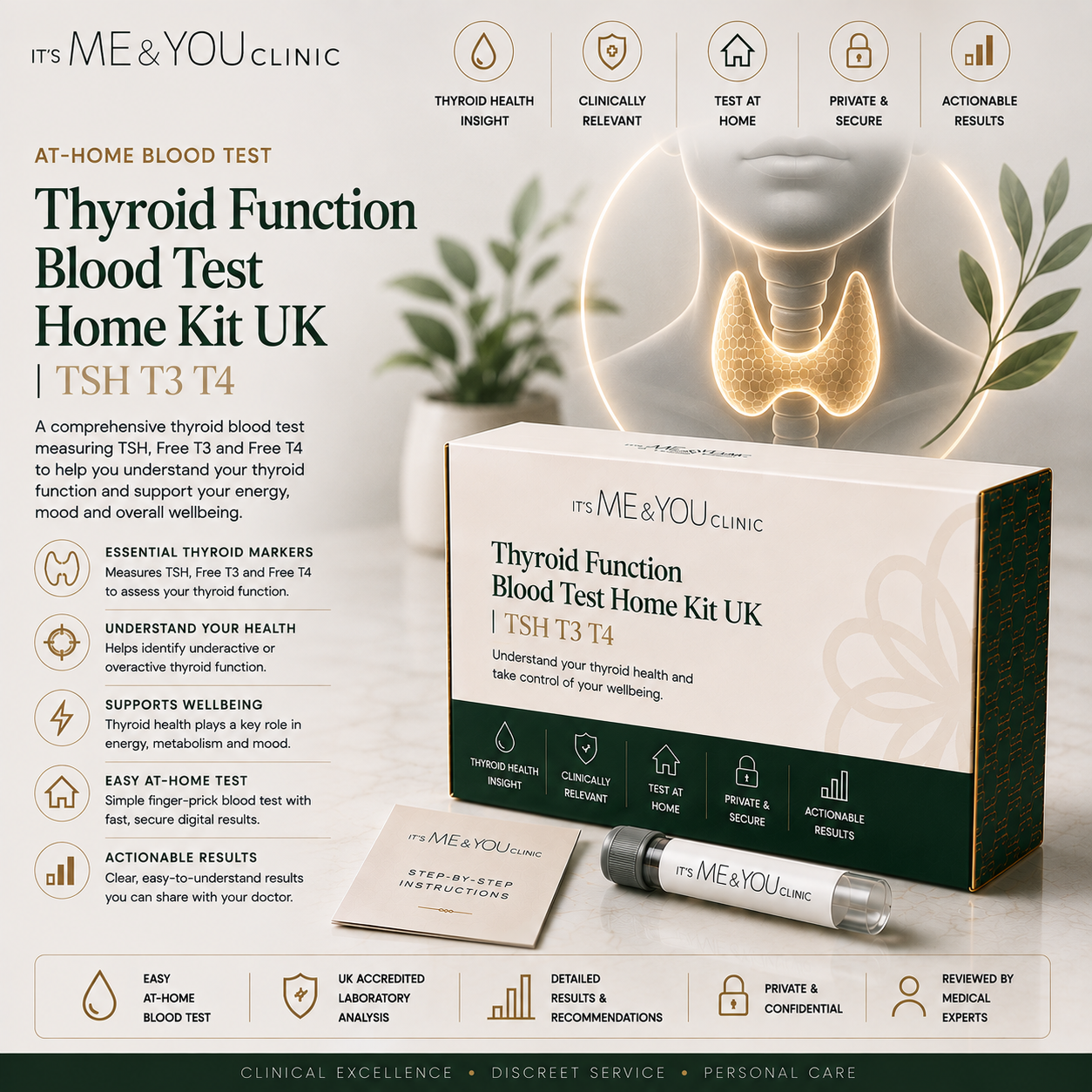
Thyroid Function Blood Test Home Kit UK
A focused thyroid route where tiredness, palpitations, temperature sensitivity, bowel change, mood change or weight change may not be explained by menopause alone.
- Focus
- TSH, T3 and T4 as stated on the product page
- May be relevant when
- A defined thyroid function question
- Important limit
- Does not confirm or exclude menopause, and biotin, medicines, pregnancy and illness may affect interpretation

Thyroid hormones and antibodies
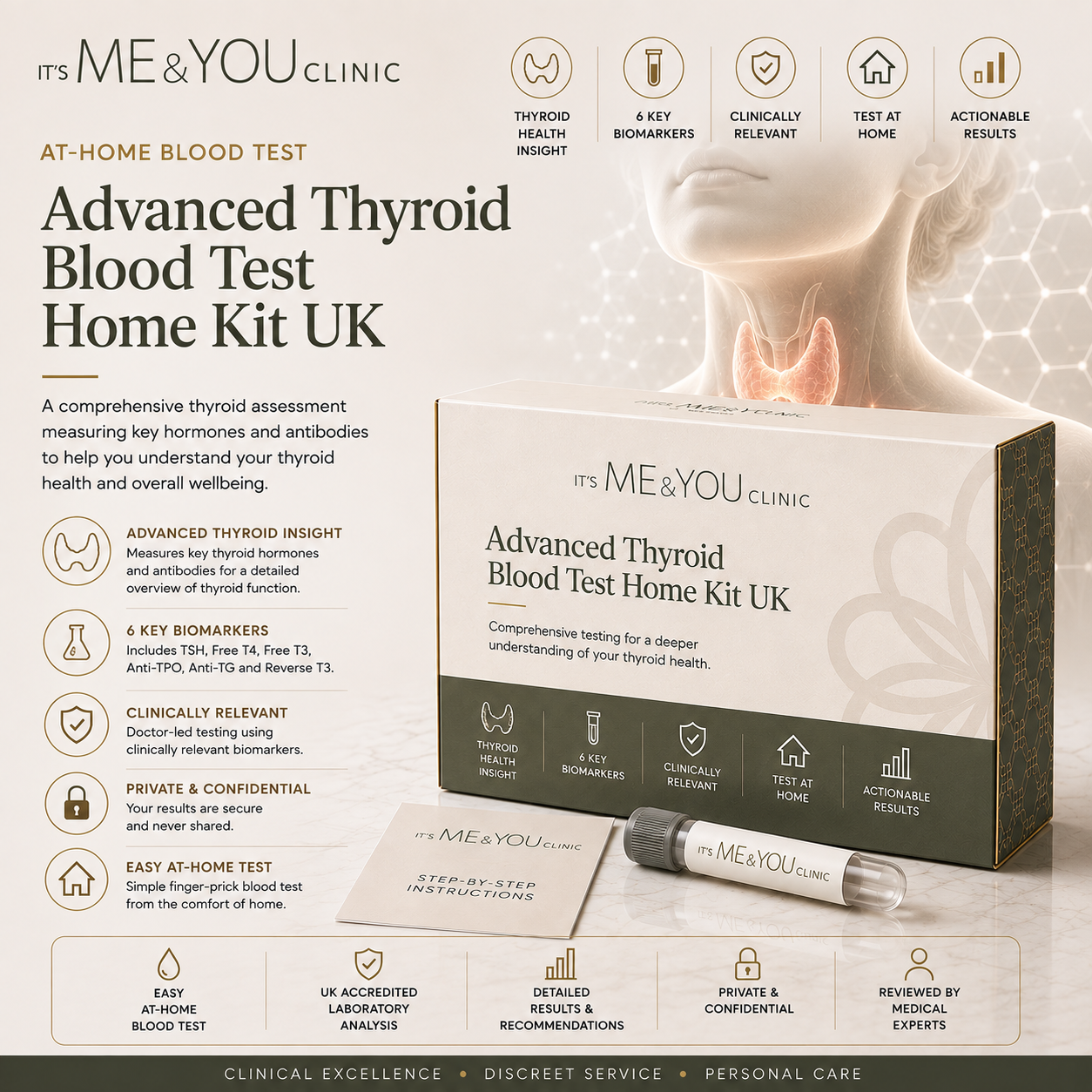
Advanced Thyroid Blood Test Home Kit UK
A broader thyroid route for people who specifically need the additional antibody measurements listed on the product page.
- Focus
- Thyroid function markers with the listed thyroid antibody measurements
- May be relevant when
- A selected autoimmune thyroid question where antibody context is genuinely relevant
- Important limit
- A larger panel is not automatically more useful, and antibodies do not explain every symptom

Focused vitamin D status
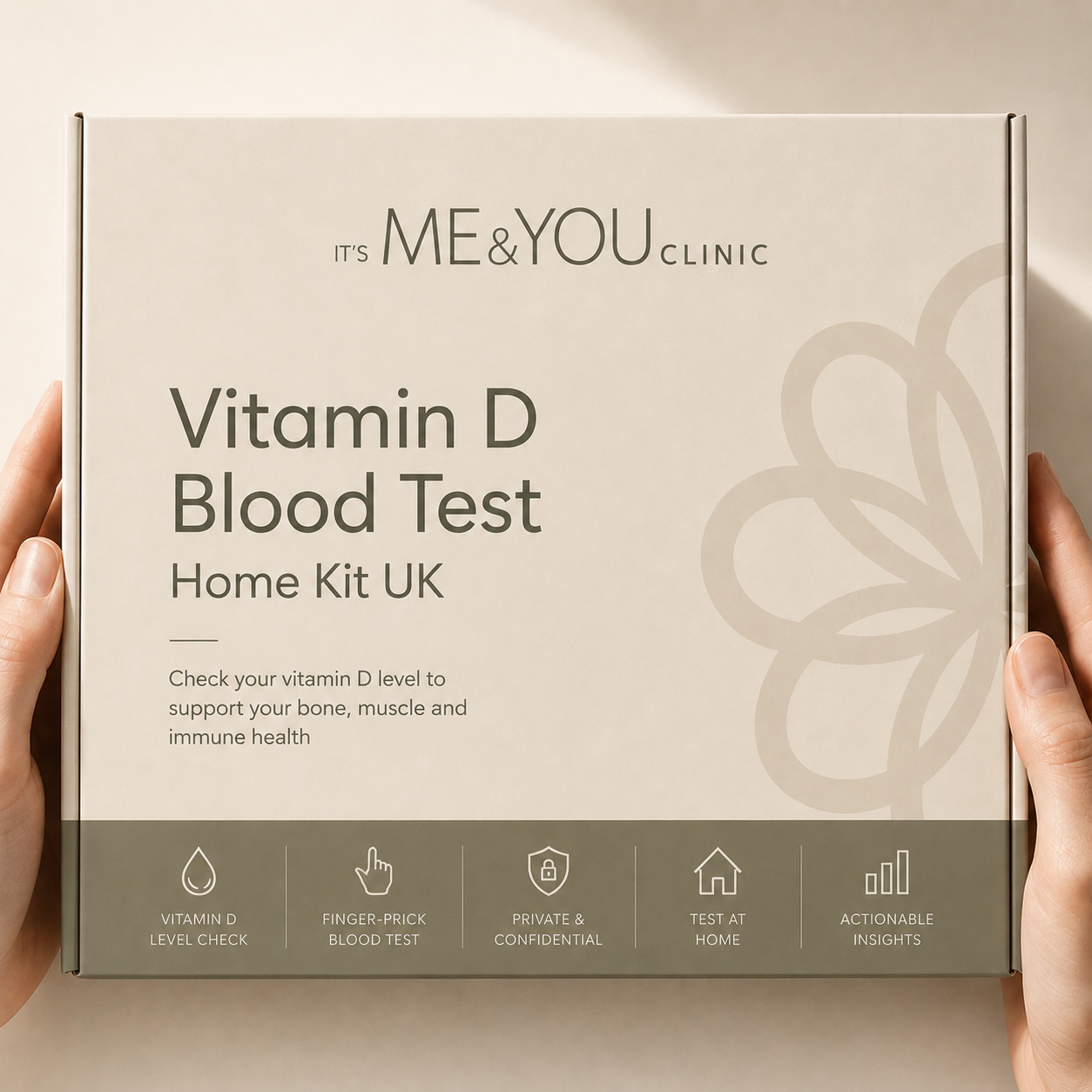
Vitamin D Blood Test Home Kit UK
A single marker option where vitamin D is the defined question, including previous deficiency, limited sun exposure or clinician advised monitoring.
- Focus
- 25 hydroxyvitamin D
- May be relevant when
- A specific vitamin D or bone health related question
- Important limit
- Does not diagnose menopause or osteoporosis and does not provide a complete fracture risk assessment
Side by side comparison
Which menopause related blood test answers which question?
| Test | Main focus | May be relevant when | Important limit |
|---|---|---|---|
| Female Hormone Blood Test | LH, FSH, testosterone, SHBG and calculated free androgen index | A clinically directed reproductive hormone question, particularly before age 45 or where the presentation is atypical | Does not diagnose menopause, PCOS, infertility or HRT suitability by itself |
| Thyroid Function Blood Test | TSH, T3 and T4 as stated on the product page | A defined thyroid function question | Does not confirm or exclude menopause, and biotin, medicines, pregnancy and illness may affect interpretation |
| Advanced Thyroid Blood Test | Thyroid function markers with the listed thyroid antibody measurements | A selected autoimmune thyroid question where antibody context is genuinely relevant | A larger panel is not automatically more useful, and antibodies do not explain every symptom |
| Vitamin D Blood Test | 25 hydroxyvitamin D | A specific vitamin D or bone health related question | Does not diagnose menopause or osteoporosis and does not provide a complete fracture risk assessment |
Plain English marker guide
What the selected markers may add
A pituitary hormone that may rise as ovarian function declines. Levels fluctuate and may be altered by hormonal treatment.
A pituitary hormone involved in ovulation and ovarian function. It is not used alone to diagnose menopause.
These can provide androgen context. Calculated free androgen index must be interpreted cautiously and does not diagnose PCOS.
These markers provide thyroid function context where symptoms overlap with menopause or suggest a separate thyroid question.
Antibodies may support autoimmune thyroid context in selected cases but do not explain every symptom.
Vitamin D contributes to bone health, but one result does not provide a complete osteoporosis or fracture risk assessment.
Timing, treatment and interpretation
Improve the usefulness of any selected test
These are central to clinical menopause assessment and provide essential context for hormone results.
Hormonal treatment can alter bleeding patterns and hormone measurements.
Do not stop HRT, contraception or prescribed medicines simply to obtain a home result.
High dose biotin supplements may interfere with selected thyroid and hormone immunoassays.
Pregnancy may remain possible during perimenopause and requires the appropriate clinical pathway.
Bleeding after menopause requires prompt clinical assessment rather than a home hormone panel.
From order to result
How home blood testing works
Define the clinical question and check whether testing is necessary.
Record age, cycle day, medicines, HRT, contraception and supplements.
Use the supplied equipment and follow every collection instruction.
Package the sample and use the specified return pathway promptly.
Interpret the result with symptoms and arrange proportionate follow up.
Laboratory analysis and reporting
A defined pathway after the sample leaves your home
Hormone, thyroid and vitamin D measurements use assay specific methods and quality controls. The sample must be identified, accepted, analysed using the correct method and reported through the relevant secure pathway.
Laboratory, accreditation, sample stability and reporting details can differ between products. Check the current individual product page rather than assuming one standard applies across every test.


Clinic address
Ground floor
Siddeley House
50 Canbury Park Road
Kingston upon Thames
KT2 6LX
Doctor led care in Kingston
Support when symptoms, bleeding or treatment choices need more judgement
It’s Me & You Clinic is led by Dr Laura Geige and is located around five minutes from Kingston station. The clinic is convenient for Kingston, Norbiton, Surbiton, Richmond, Hampton Wick, New Malden and neighbouring Surrey areas.
The Rotunda, Bentall Centre, Fenwick, cafés and Kingston riverside are nearby. Drivers can use central off street parking serving the Bentall Centre and the wider town centre.
Medical and editorial review
Menopause boundaries, healthy ageing and patient pathway review
The page has been reviewed for clinical diagnosis boundaries, abnormal bleeding, thyroid overlap, vitamin D and bone context, HRT wording, assay limitations and appropriate follow up.

Medical oversight
Dr Laura Geige
Reviewed clinical diagnosis boundaries, urgent bleeding advice, pregnancy safeguards and the distinction between laboratory information and treatment planning.
View professional profile
Healthy ageing context
Dr Rimas Geiga
Reviewed vitamin D, bone health, metabolic, nutritional and healthy ageing context, including the limits of one vitamin result.
View professional profile
Patient pathways
Veronika Matutyte
Reviewed preparation, treatment interference, laboratory pathways, diagnostic limitations and patient centred follow up communication.
View professional profileMedical and editorial review date: 4 August 2026. General website information is educational and does not replace individual medical advice.
UK guidance and further reading
Selected official clinical sources
Guidance covering clinical identification, selected use of FSH, symptom management and treatment decision making.
A quality statement explaining why typical menopause in people aged 45 or over is identified without routine laboratory tests.
Patient information on symptoms, when to seek help and available treatment pathways.
Information on menopause before age 45 and why clinical assessment is important.
Guidance relevant where thyroid symptoms overlap with menopause or perimenopause.
Bone health context extending beyond one vitamin D measurement.
Frequently asked questions
Menopause and perimenopause blood tests
Do I need a blood test to diagnose menopause?
Usually not when you are aged 45 or over and have typical symptoms and menstrual changes. In this group, menopause is generally identified clinically.
When may FSH testing be considered?
FSH may be considered in selected people aged 40 to 45 with symptoms and cycle change, or under 40 when menopause is suspected. This should be clinically directed.
Can one normal FSH result rule out perimenopause?
No. FSH fluctuates during perimenopause and one result may not represent the wider picture.
Can HRT affect hormone blood tests?
Yes. HRT and hormonal contraception can alter hormone levels and bleeding patterns. Do not stop treatment without advice.
Why might thyroid testing be relevant?
Thyroid dysfunction may cause tiredness, palpitations, temperature sensitivity, weight change, bowel change and mood symptoms that overlap with menopause.
Should I choose the focused or advanced thyroid test?
Choose the focused test for a thyroid function question. Choose the advanced panel only when the additional antibody information is specifically relevant.
Does vitamin D testing diagnose osteoporosis?
No. Vitamin D is one part of bone health. Osteoporosis assessment may require fracture risk review and bone density scanning.
Can AMH diagnose menopause?
No. The supplied guidance states that AMH should not be used to identify perimenopause or menopause in people aged 45 or over.
Can blood tests tell me whether HRT is suitable?
No. HRT suitability depends on symptoms, medical history, bleeding pattern, risks, preferences and clinical assessment.
What should I do about bleeding after menopause?
Arrange prompt medical assessment. Do not rely on a home hormone test.
Can biotin affect thyroid results?
Yes. High dose biotin supplements may interfere with selected thyroid and hormone immunoassays.
Can normal results exclude every cause of my symptoms?
No. Sleep problems, mood, medicines, cardiovascular conditions, gynaecological conditions and other causes may not be measured by the selected panel.
Choose with clinical clarity
Use blood testing only when it answers a specific question that symptoms and history cannot answer alone
Compare the four related testing routes when home collection is appropriate, or contact the doctor led Kingston clinic when bleeding, treatment, age or symptom overlap makes the next step less straightforward.
These tests provide selected laboratory information and do not replace clinical menopause assessment, diagnosis, emergency care or treatment planning.