





Doctor led men’s health testing from Kingston
Men’s Health and Testosterone Blood Tests UK
Five carefully separated home testing routes for total testosterone, binding context, broader male hormones, reproductive hormones and PSA.
Low libido, tiredness, sexual changes, altered body composition and fertility concerns are not diagnoses of testosterone deficiency. A useful test begins with the question, the correct morning timing and an understanding of what the selected panel cannot show.


The collection at a glance
Five tests, five different questions
The total testosterone test is deliberately narrow. The advanced panel adds binding proteins and calculations. The complete panel adds wider endocrine signalling. The fertility panel addresses a reproductive pathway, while the PSA test measures a prostate marker rather than a hormone.
Selecting the largest panel is not automatically the most useful choice. The best option is the one whose reported markers can meaningfully answer the question.
One total testosterone measurement.
Testosterone with SHBG, albumin and calculations.
Testosterone, binding, pituitary and reproductive markers.
Selected reproductive signalling without semen analysis.
A prostate marker with distinct preparation requirements.
Sudden severe testicular pain, inability to pass urine, blood in the urine with clots, chest pain, collapse, new weakness or speech change, severe confusion or thoughts of self harm require urgent assessment.
Start with the actual question
Common reasons for considering men’s health testing
Useful when the objective is simply to measure total testosterone at the appropriate time.
SHBG, albumin and calculated values may provide additional binding context.
LH, FSH, prolactin and DHEA S may add context to a broader endocrine question.
Blood hormones can add context, but semen analysis remains central to sperm assessment.
PSA is a separate prostate marker and should not be bundled casually into a testosterone question.
Test timing and marker selection should follow the clinician responsible for treatment.
Correct It’s Me & You Clinic products
Home testosterone, male hormone, fertility and PSA tests
The five products below use the current It’s Me & You Clinic product routes and their corresponding clinic imagery.
One marker
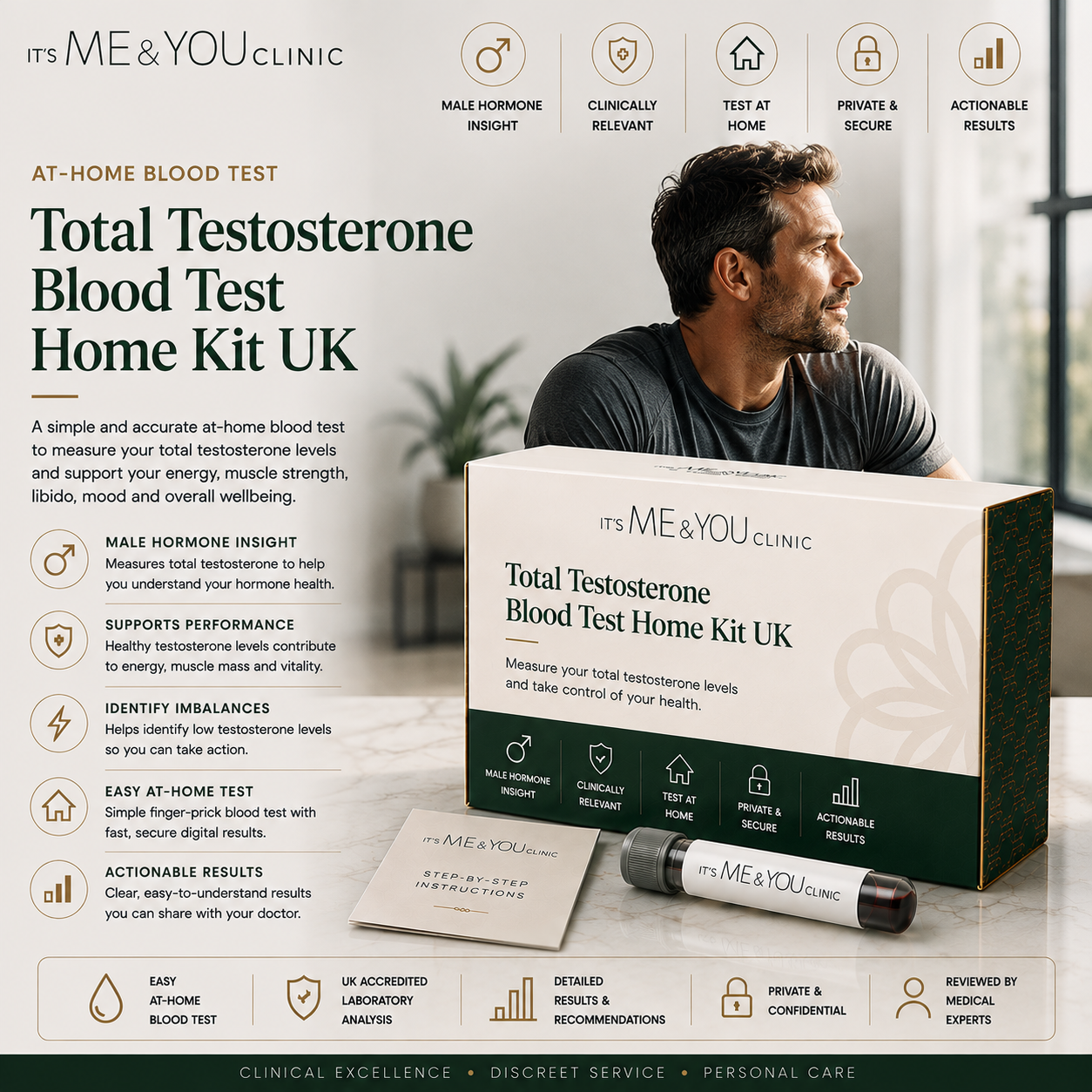
Total Testosterone Blood Test Home Kit UK
The most concise route in the collection, designed for a single total testosterone result when the question is deliberately narrow.
- Reported
- Total testosterone
- Most relevant when
- A focused morning baseline or an agreed repeat measurement
- Important limit
- Does not show SHBG, calculated free testosterone, pituitary hormones, fertility or prostate health

Five markers and calculations
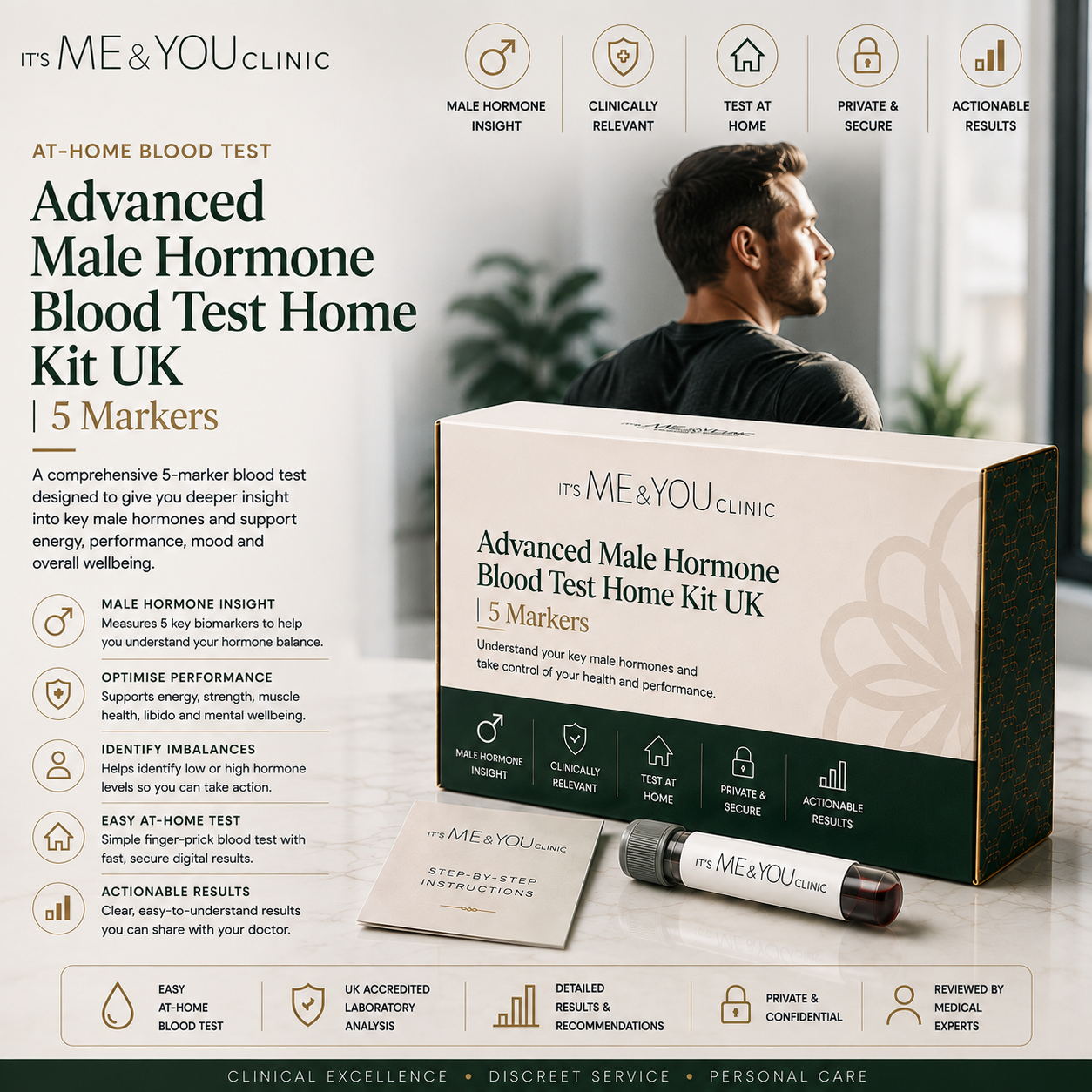
Advanced Male Hormone Blood Test Home Kit UK
A more interpretive testosterone route where binding proteins and calculated androgen measures are relevant to the question.
- Reported
- Total testosterone, SHBG, albumin, calculated free testosterone and free androgen index
- Most relevant when
- Understanding testosterone alongside binding related context
- Important limit
- Does not provide the full pituitary and reproductive overview of the complete panel
Nine marker panel
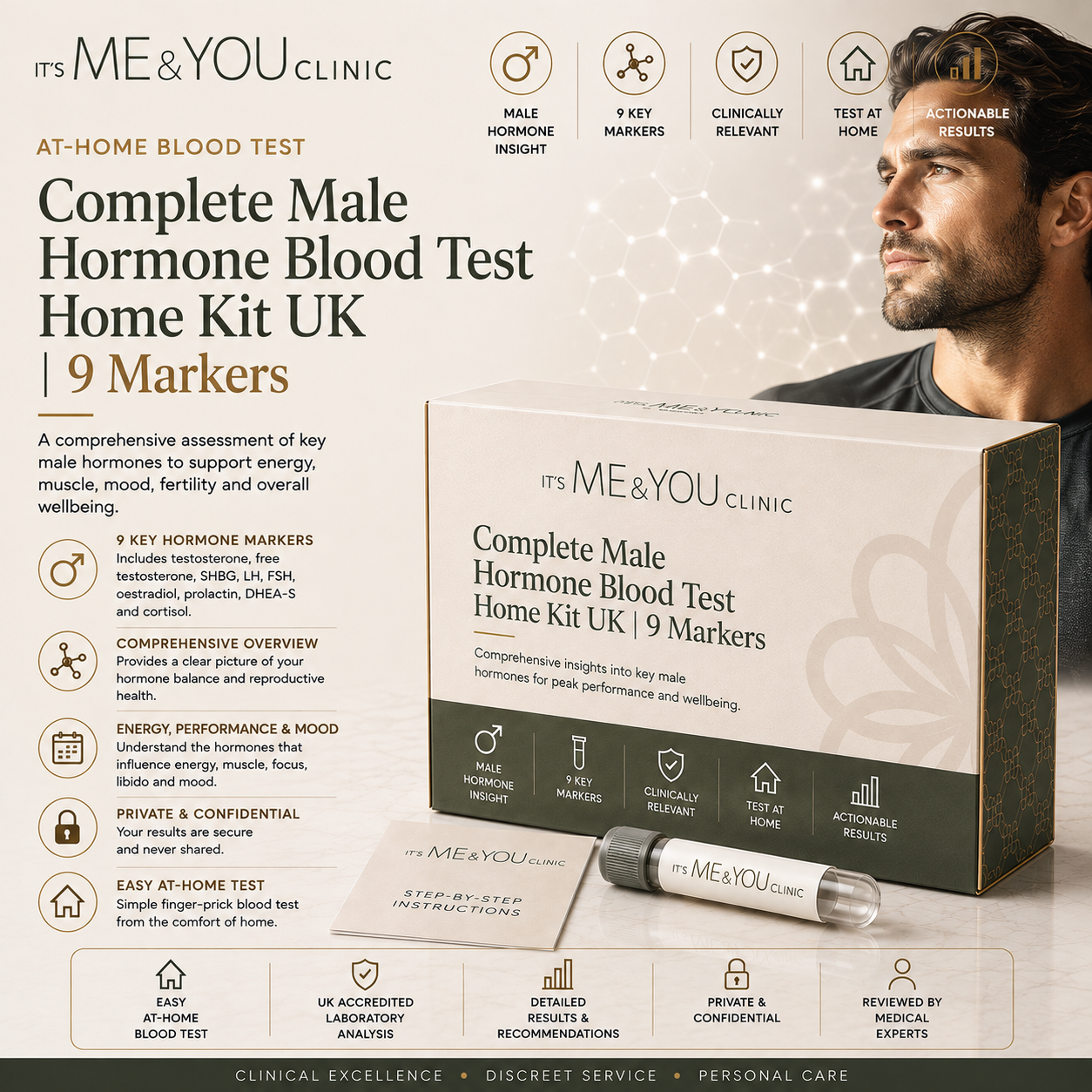
Complete Male Hormone Blood Test Home Kit UK
The widest male hormone panel in this collection, adding pituitary and reproductive signalling to testosterone and binding context.
- Reported
- Testosterone, SHBG, free testosterone, albumin, DHEA S, prolactin, LH, FSH and free androgen index
- Most relevant when
- A broader male endocrine overview
- Important limit
- More markers do not diagnose the cause of an abnormal pattern or determine treatment suitability

Eight marker reproductive panel
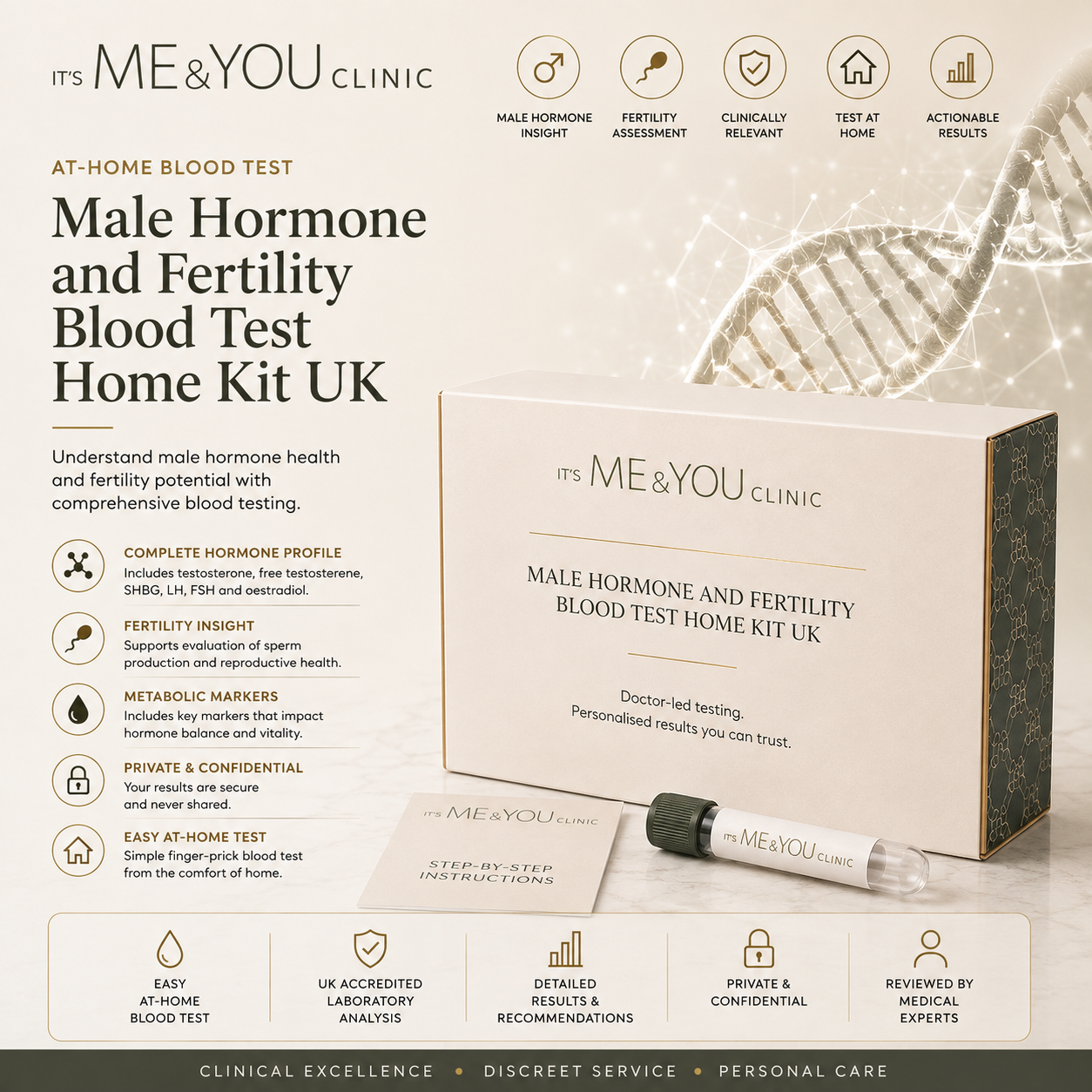
Male Hormone and Fertility Blood Test Home Kit UK
A reproductive hormone route for fertility related questions where blood markers may add context to a wider assessment.
- Reported
- Testosterone related markers with LH, FSH, prolactin and TSH as specified on the product page
- Most relevant when
- Selected reproductive hormone and testicular signalling context
- Important limit
- Cannot measure sperm count, motility, morphology or DNA quality and does not replace semen analysis

One prostate marker
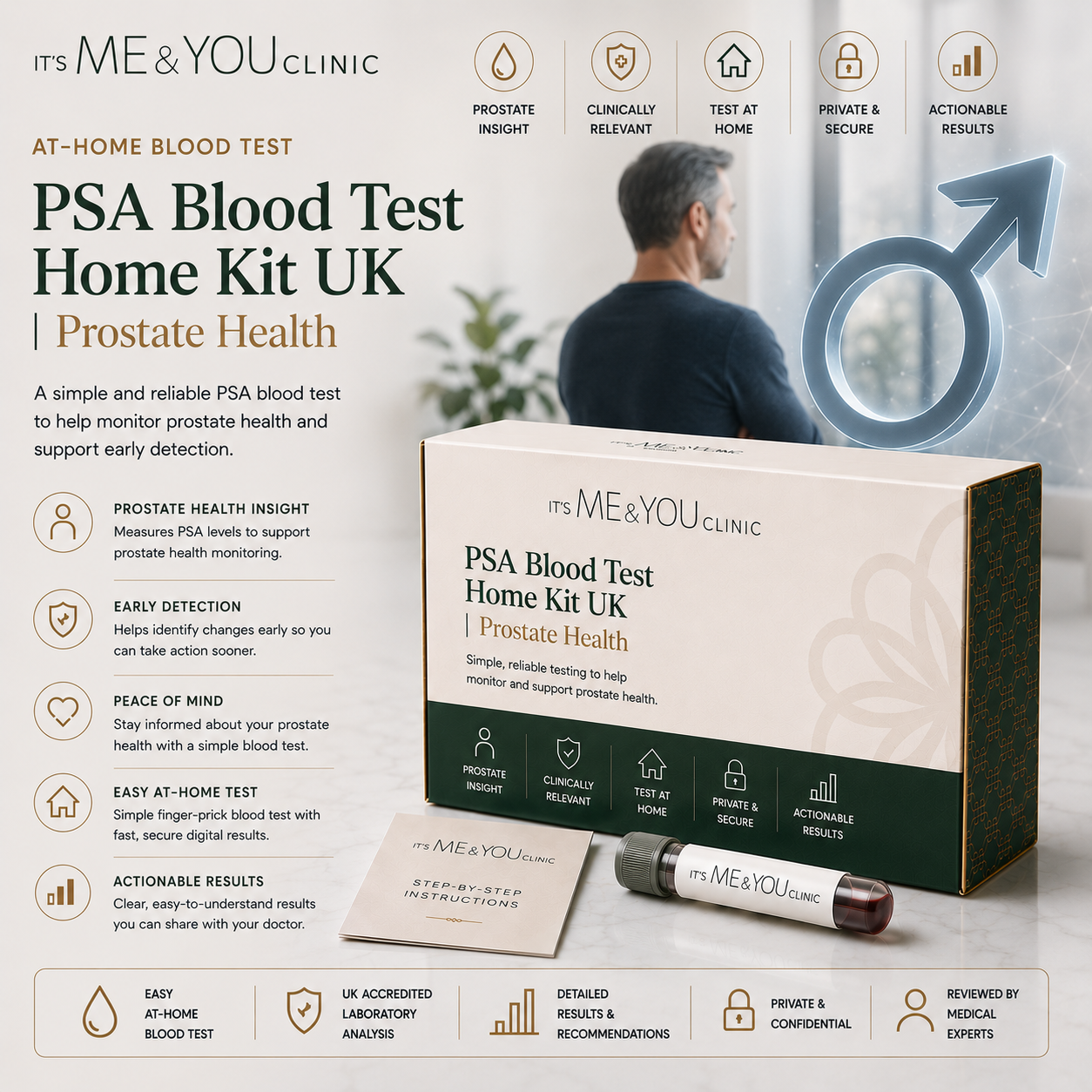
PSA Blood Test Home Kit UK
A focused prostate marker test that should be approached with preparation guidance and a clear plan for interpreting the result.
- Reported
- Total prostate specific antigen
- Most relevant when
- An informed PSA measurement with an appropriate follow up plan
- Important limit
- A raised PSA has several possible causes and a result within range does not exclude prostate cancer
Side by side comparison
Compare exactly what each test reports
| Test | Reported | Most relevant when | Important limit |
|---|---|---|---|
| Total Testosterone Test | Total testosterone | A focused morning baseline or an agreed repeat measurement | Does not show SHBG, calculated free testosterone, pituitary hormones, fertility or prostate health |
| Advanced Male Hormone Test | Total testosterone, SHBG, albumin, calculated free testosterone and free androgen index | Understanding testosterone alongside binding related context | Does not provide the full pituitary and reproductive overview of the complete panel |
| Complete Male Hormone Test | Testosterone, SHBG, free testosterone, albumin, DHEA S, prolactin, LH, FSH and free androgen index | A broader male endocrine overview | More markers do not diagnose the cause of an abnormal pattern or determine treatment suitability |
| Male Hormone and Fertility Test | Testosterone related markers with LH, FSH, prolactin and TSH as specified on the product page | Selected reproductive hormone and testicular signalling context | Cannot measure sperm count, motility, morphology or DNA quality and does not replace semen analysis |
| PSA Prostate Blood Test | Total prostate specific antigen | An informed PSA measurement with an appropriate follow up plan | A raised PSA has several possible causes and a result within range does not exclude prostate cancer |
Biomarker guide
How the principal male hormone and prostate markers differ
Measures circulating testosterone in bound and unbound forms. One isolated result does not diagnose deficiency.
A binding protein that can change the relationship between total and available testosterone.
A more weakly binding blood protein used in some calculated free testosterone approaches.
An estimate derived from total testosterone and binding proteins rather than a universal direct measurement.
Pituitary hormones that may help clinicians consider testicular and central signalling patterns.
A pituitary hormone influenced by stress, medicines and collection conditions.
An adrenal androgen that adds context within a broader hormone panel.
A thyroid related marker included in the reproductive panel where the current product specification states it.
A protein produced by prostate tissue. It is not a stand alone cancer diagnosis or exclusion test.
Timing matters
Collect testosterone tests in the advised morning window
Testosterone follows a daily rhythm. Morning collection is commonly used when investigating possible deficiency, and a low or borderline result may need appropriately timed confirmation.
Confirm collection time, fasting, sample type, activation and return requirements.
Include testosterone therapy, anabolic steroids, fertility treatment and relevant medicines.
Follow the clinician’s monitoring plan rather than changing treatment for a home test.
Acute illness and disrupted sleep may affect the wider clinical picture.
Use similar timing and the same laboratory method where practical.
Unexpected results may require venous sampling, repeat testing or endocrine assessment.
Male fertility
Hormone testing cannot assess sperm directly
Testosterone, LH, FSH and prolactin may provide selected reproductive signalling context. They do not measure sperm concentration, movement, morphology or DNA quality.
- Semen analysis may be central to fertility assessment
- External testosterone and anabolic steroids can suppress sperm production
- Medical history, examination, infection, genetics and partner factors may matter
PSA and prostate health
Use PSA with preparation and follow up
PSA may rise with benign enlargement, inflammation, infection, ejaculation, cycling, strenuous exercise and recent prostate procedures as well as cancer.
- A raised result does not diagnose prostate cancer
- A result within range does not completely exclude cancer
- Persistent urinary or prostate concerns require medical assessment
From order to result
How home men’s health testing works
Select the panel whose reported markers match the question.
Review morning timing, medicines, fasting and PSA instructions.
Use the supplied equipment and provide the required sample.
Package and return the sample through the specified pathway promptly.
Interpret the complete pattern and arrange proportionate follow up.
Laboratory analysis and reporting
Hormones, calculations and PSA use different analytical pathways
Total testosterone, SHBG, albumin, pituitary hormones, prolactin, thyroid markers and PSA require method specific analysis and quality controls. Calculated values also depend on the underlying measurements and formula used.
Laboratory, accreditation, sample stability and reporting details can differ between products. The individual product specification remains the definitive source for the pathway applying to that kit.


Clinic address
Ground floor
Siddeley House
50 Canbury Park Road
Kingston upon Thames
KT2 6LX
Doctor led care in Kingston
Support when symptoms or hormone results need individual judgement
It’s Me & You Clinic is led by Dr Laura Geige and is located around five minutes from Kingston station. The clinic is convenient for Kingston, Norbiton, Surbiton, Richmond, Hampton Wick, New Malden and neighbouring Surrey areas.
The Rotunda, Bentall Centre, Fenwick, cafés and Kingston riverside are nearby. Drivers can use central off street parking serving the Bentall Centre and wider town centre.
Medical and editorial review
Men’s health, metabolic context and patient pathway oversight

Medical oversight
Dr Laura Geige
Clinical scope includes urgent symptom boundaries, responsible test selection and the distinction between laboratory information and diagnosis.
View professional profile
Hormone and metabolic context
Dr Rimas Geiga
Clinical scope includes testosterone, body composition, metabolic health, nutrition and the wider causes of non specific male symptoms.
View professional profile
Patient pathways
Veronika Matutyte
Clinical scope includes laboratory governance, PSA safeguards, preparation, privacy and appropriate result follow up.
View professional profileGeneral website information is educational and does not replace individual medical advice, examination or treatment planning.
UK guidance and further reading
Selected men’s health, testosterone and PSA sources
Explains that late onset hypogonadism is a specific medical condition assessed using symptoms and testosterone blood tests.
Clinical guidance on testosterone testing and repeat assessment where a result is low or borderline.
Preparation guidance and explanation of factors that can affect PSA results.
Current UK screening recommendation and the distinction between targeted and population screening.
Peer reviewed guidance on testosterone deficiency and replacement therapy in men.
Clinical context for hormone testing, semen analysis and broader fertility assessment.
Frequently asked questions
Men’s health and testosterone blood tests
Which testosterone blood test should I choose?
Choose total testosterone for a focused baseline, the advanced panel for binding related context, and the complete panel for a broader hormone overview.
What is included in the advanced male hormone test?
The current product reports total testosterone, SHBG, albumin, calculated free testosterone and free androgen index.
What is included in the complete male hormone test?
The current product reports nine markers and calculations: testosterone, SHBG, free testosterone, albumin, DHEA S, prolactin, LH, FSH and free androgen index.
Can one result diagnose low testosterone?
No. Diagnosis requires relevant symptoms, appropriately timed measurements and clinical assessment.
When should I collect a testosterone sample?
Morning collection is commonly recommended. Follow the exact instructions supplied with the selected kit.
Can the fertility hormone panel tell me whether I am fertile?
No. It does not measure sperm concentration, movement, morphology or DNA quality. Semen analysis may be required.
Can anabolic steroids affect male hormone results?
Yes. They can suppress LH and FSH, alter testosterone measurements and reduce sperm production.
Does a raised PSA mean prostate cancer?
No. PSA may rise because of benign enlargement, inflammation, infection, ejaculation, cycling, exercise or recent procedures as well as cancer.
Does a PSA result within range rule out prostate cancer?
No. Persistent symptoms or concerns still require medical assessment.
What should I avoid before a PSA test?
Follow the kit instructions. NHS guidance advises avoiding ejaculation, cycling and strenuous exercise for 48 hours before testing.
Can I test while using testosterone therapy?
Testing may form part of monitoring, but timing depends on the formulation and clinical plan. Do not alter treatment without advice.
Are the correct It’s Me & You Clinic products included?
Yes. The collection contains the current total testosterone, advanced male hormone, complete male hormone, male hormone and fertility, and PSA product routes with their matching clinic images.
Choose the scope deliberately
Start with the narrowest test that can answer the question
Compare the five corresponding It’s Me & You Clinic products, or contact the doctor led Kingston clinic when symptoms, treatment, fertility or prostate concerns make the next step less straightforward.
These tests provide selected laboratory information and do not replace diagnosis, emergency care, fertility assessment, prostate investigation or treatment planning.