




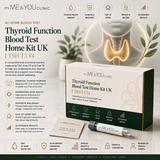
Blood test home kit UK
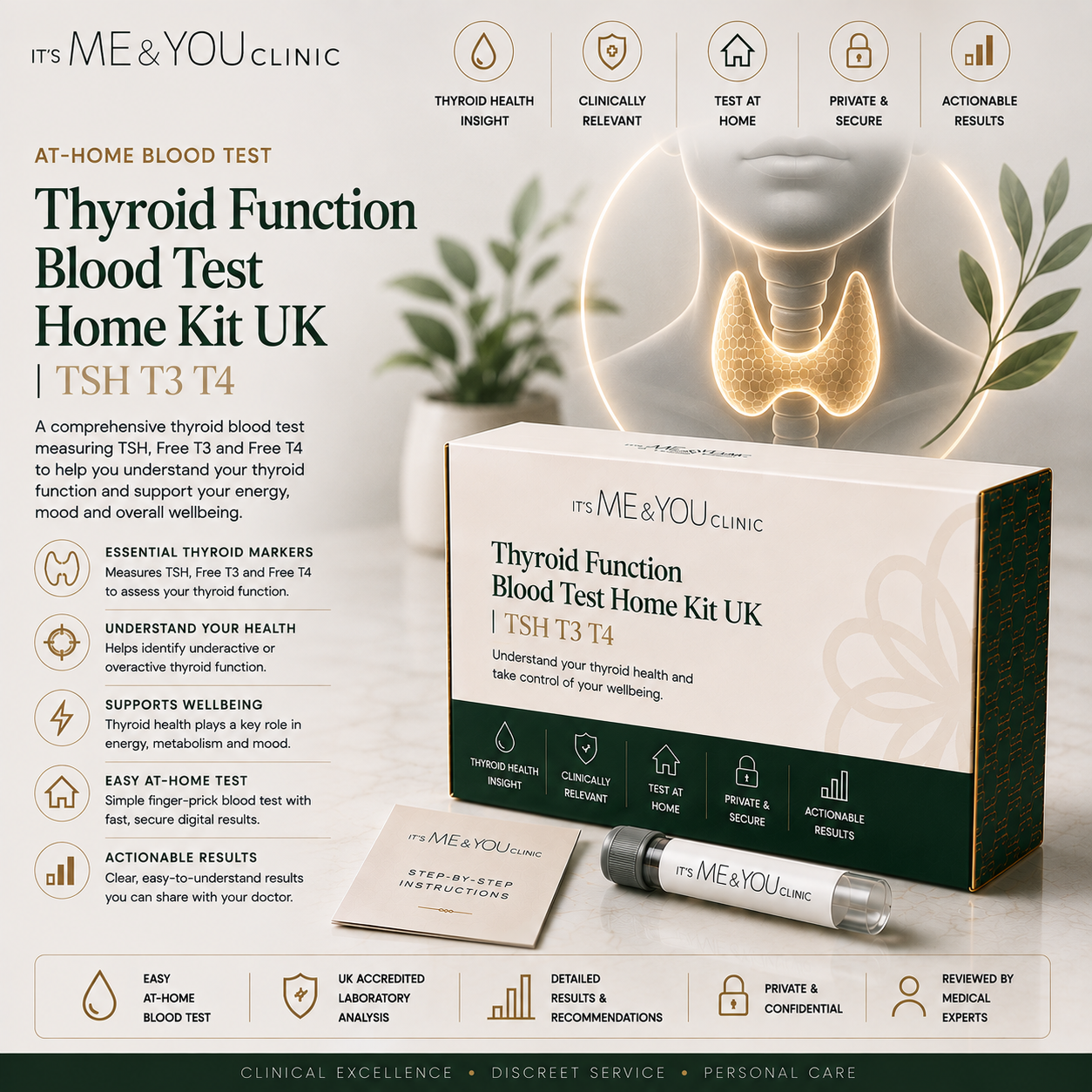
Thyroid Function Blood Test Home Kit UK
A core three marker thyroid function panel measuring the pituitary signal and the two principal free thyroid hormones.
What this product is designed to clarify: This panel answers a narrower question than the advanced antibody test. It looks at current thyroid function through TSH, free T4 and free T3 without testing TPO or thyroglobulin antibodies.
When the product may be useful
Begin with the reason for testing
- Persistent tiredness with cold or heat intolerance
- Unexplained weight or bowel change
- Palpitations, tremor or sweating
- An earlier abnormal TSH result
- Monitoring requested by a clinician
- Assessing thyroid antibodies or autoimmune cause
- Investigating a neck lump or structural thyroid disease
- Changing levothyroxine or antithyroid medicine from one result
- Severe palpitations, chest pain, collapse or confusion
The report at a glance
What is measured and what remains outside the kit
A three part feedback loop
How TSH, free T4 and free T3 relate
Common function patterns
How TSH changes the meaning of T4 and T3
Core function panel
What it is designed to show
The product focuses on current thyroid function through TSH, free T4 and free T3.
Thyroid antibodies
TPO and thyroglobulin antibodies are part of the separate advanced thyroid product and are not measured here.
Three marker interpretation
Result bands and next step guidance
Free triiodothyronine (free T3)
Free T3 is the unbound fraction of triiodothyronine in the blood. T3 is the more biologically active thyroid hormone, and much of it is produced outside the thyroid through conversion from T4.
A very low result may occur during severe illness, advanced hypothyroidism, medicine effects or analytical problems.
Follow the laboratory escalation advice and Arrange prompt clinical review.May occur with non thyroidal illness, calorie restriction, medicines, hypothyroid patterns or treatment factors.
Interpret with TSH, free T4, symptoms and recent illness.Falls within the laboratory interval.
A normal free T3 does not exclude early hypothyroidism, structural thyroid disease or autoimmune thyroid disease.May occur with hyperthyroidism, T3 predominant thyrotoxicosis or liothyronine treatment.
Discuss the result with a GP and review TSH, free T4, medicines and symptoms.A markedly raised result with severe symptoms may indicate significant thyrotoxicosis.
Seek urgent clinical assessment, especially with a fast heartbeat, chest pain, breathlessness, fever, agitation or confusion.Thyroid stimulating hormone (TSH)
TSH is produced by the pituitary gland and signals the thyroid to produce thyroid hormones. It is usually the first laboratory marker used when primary thyroid dysfunction is suspected.
A markedly suppressed TSH may occur with overt hyperthyroidism, excessive thyroid hormone treatment, pregnancy, severe illness or medicine effects.
Arrange prompt clinical review, particularly when free T4 or free T3 is raised.May occur with hyperthyroidism, subclinical hyperthyroidism, thyroid hormone treatment, pregnancy, illness, medicines or pituitary dysfunction.
Review free T4, free T3, symptoms and treatment timing.Falls within the laboratory reference interval.
A normal TSH reduces the likelihood of primary overt thyroid dysfunction but does not assess nodules, antibodies or every pituitary condition.Commonly occurs when the thyroid is underactive, especially when free T4 is low. It may also reflect medicine timing, adherence, recovery from illness or pregnancy requirements.
Discuss repeat testing, symptoms, free T4 and treatment with a GP.A markedly raised TSH may indicate significant untreated hypothyroidism or inadequate replacement, although interpretation depends on free T4 and clinical status.
Arrange prompt medical review and follow the laboratory escalation advice.Free thyroxine (free T4)
Free T4 is the unbound fraction of thyroxine circulating in the blood. T4 is produced mainly by the thyroid and can be converted into the more active hormone T3 in tissues.
A very low result may occur with significant primary hypothyroidism, central hypothyroidism, severe illness or treatment effects.
Arrange prompt clinical review, especially with drowsiness, confusion, hypothermia, severe weakness or breathing problems.With high TSH, this commonly supports primary hypothyroidism. With low or normal TSH, central hypothyroidism, illness, medicine effects or assay issues may need consideration.
Discuss the complete pattern with a GP and do not adjust treatment alone.Falls within the laboratory interval.
Interpret with TSH, symptoms, treatment, pregnancy status and previous results.With low TSH, this may support hyperthyroidism or excessive thyroid hormone treatment. Discordant patterns can arise from medicines, biotin, pregnancy or assay interference.
Discuss the pattern and medicine timing with a clinician.A markedly raised result with severe symptoms may indicate significant thyrotoxicosis.
Seek urgent clinical assessment, particularly with chest pain, a very fast heartbeat, severe breathlessness, fever, agitation or confusion.Preparation and collection quality
Before taking the sample
- Fasting is not usually required unless the kit states otherwise
- Continue prescribed thyroid medicine unless advised differently
- Record the product, dose and time of the most recent thyroid dose
- Record high dose biotin and follow laboratory guidance
- Record pregnancy, recent illness and medicines that may affect results
Small preparation details can change interpretation
Laboratory methods, sample stability and collection devices vary. An insufficient, delayed, contaminated or incorrectly labelled sample may not be suitable for analysis.
From selection to secure report
How this home testing pathway works
Record medicine timing
Include the dose and time of thyroid treatment and any high dose biotin.
Collect the capillary sample
Follow the required fill volume and labelling instructions.
Return within stability
Use the supplied packaging and dispatch timing.
Start with TSH
The pituitary signal is the usual first part of the pattern.
Add free T4 and free T3
These hormones help describe overt, subclinical and low TSH patterns.
Escalate symptoms appropriately
Severe palpitations, chest pain, collapse or confusion require urgent care.
Fact checked and medically reviewed
Clinical and editorial oversight
This page was rebuilt from the supplied laboratory specification and checked against the UK medical, regulatory and professional sources listed below. Medical review is attributed to Veronika Matutyte, Dr Snieguole Geige, Dr Giedre Narkiene. The wider clinic advisory network is shown in compact form.
 Dr Laura GeigeMedical Director, Senior Practitioner and Skin Expert Advisory contributor
 Dr Giedre NarkieneMedical Doctor, Board Certified Dermatologist and Advisory Board Member Page reviewer
 Veronika MatutyteMedical Doctor, Healthcare Management Expert and Advisory Board Member Page reviewer
 Dr Snieguole GeigeAesthetic Dentist, Medical Doctor and Advisory Board Member Page reviewer
 Dr Rimas GeigaMedical Doctor, Nutritional Sciences Adviser and Advisory Board Member Advisory contributor
It’s Me & You Clinic in Kingston upon Thames
Local continuity for private laboratory results
The Kingston clinic offers a consultation led setting for thyroid results that need to be considered alongside symptoms, pregnancy status, medicines, recent illness and previous laboratory trends.
Clinic details
Office 7, Siddeley House, 50 Canbury Park Road
Kingston upon Thames KT2 6LX
Questions people ask before ordering
Concise answers without heavy FAQ cards
How is this different from the advanced thyroid test?
This panel measures TSH, free T4 and free T3. It does not include TPO or thyroglobulin antibodies.
Is TSH enough on its own?
TSH is usually the first marker, but free T4 and free T3 can help describe overt, subclinical or low TSH patterns.
Do I need to fast?
Fasting is not usually required, but follow the kit instructions and record medicine timing.
Can biotin interfere with results?
Yes. High dose biotin can affect some thyroid assays. Follow laboratory or clinician guidance.
Does a normal panel rule out every thyroid problem?
No. It does not assess nodules, antibodies or every pituitary and structural condition.
UK medical, professional and laboratory references
Sources used for this page
Home testing provides laboratory information, not a diagnosis or personal treatment plan. Do not delay urgent care while waiting for a kit or result. Call 999 for a medical emergency. Use NHS 111 or an appropriate clinician for urgent concerns that are not immediately life threatening. Do not start, stop or alter prescribed treatment solely because of a home result.