






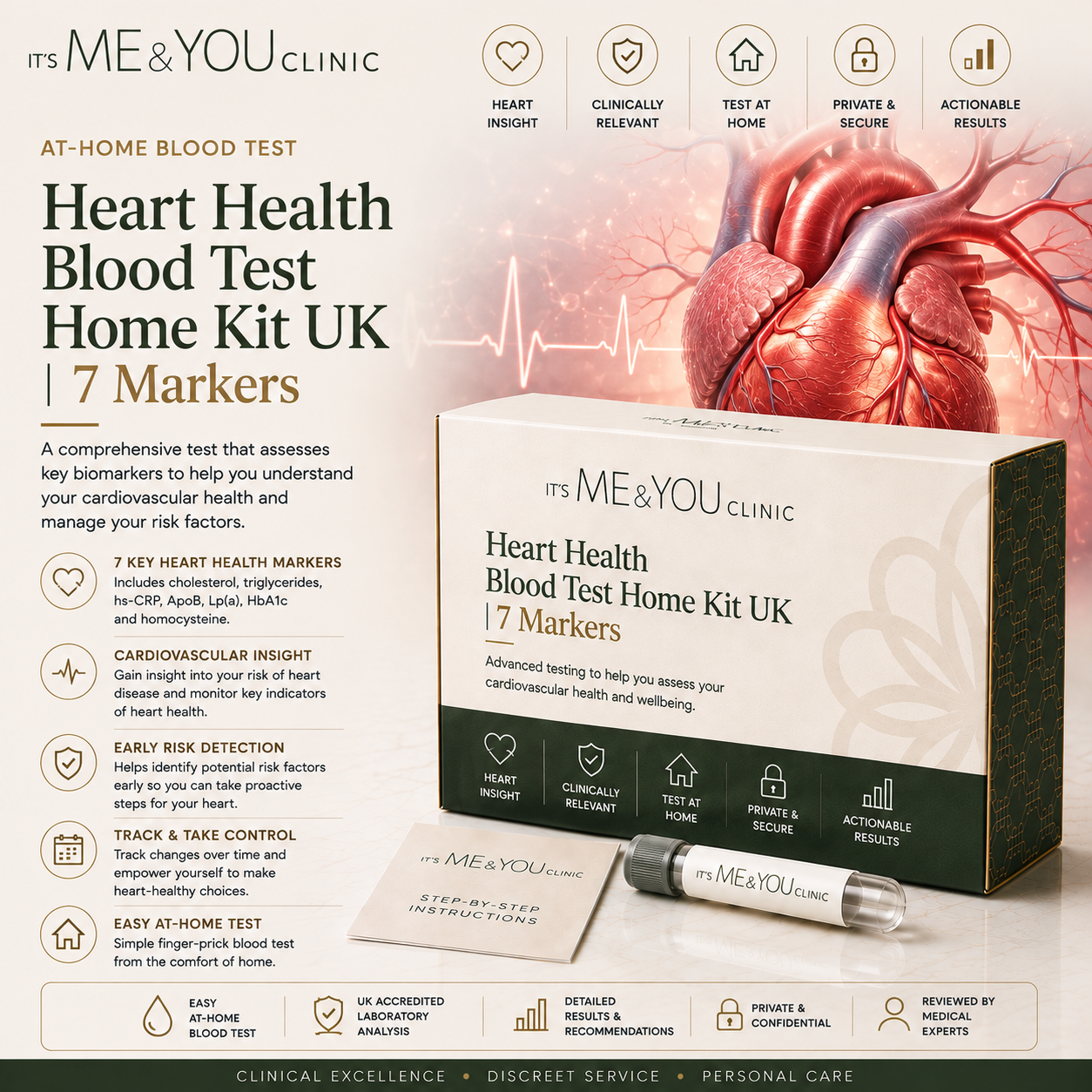




Blood test home kit UK
Heart Health Blood Test Home Kit UK
A combined lipid and HbA1c panel designed to show how cholesterol distribution, triglycerides and longer term glucose may sit within the same cardiometabolic picture.
What this product is designed to clarify: Heart risk is not one blood result. This panel adds glucose context to a full lipid profile, while explicitly leaving blood pressure, smoking, family history, kidney health and established disease outside the test.
When the product may be useful
Begin with the reason for testing
- A family history of cardiovascular disease or type 2 diabetes
- Reviewing cholesterol and HbA1c together
- A previous raised lipid or glucose result
- Monitoring a clinician agreed lifestyle or treatment plan
- Diagnosing heart disease
- Assessing chest pain, stroke symptoms or acute breathlessness
- Calculating complete cardiovascular risk without blood pressure and clinical history
- Changing statin or diabetes treatment independently
The report at a glance
What is measured and what remains outside the kit
A cardiometabolic panel, not a cholesterol duplicate
How lipids and longer term glucose intersect
Six lipid markers describe cholesterol distribution and circulating fats. HbA1c adds a separate measure of glucose exposure. Their value lies in seeing whether several risk pathways move together.
Four questions within the report
Read the panel as a sequence
Combined patterns
When the relationship between markers matters most
Seven marker cardiometabolic board
Each result explained within the purpose of this panel
LDL cholesterol
Within this cardiometabolic panel, LDL represents cholesterol carried in particles associated with atherosclerotic risk. It should be considered with non HDL cholesterol, blood pressure, smoking and diabetes risk.
Very low LDL may reflect intensive treatment, genetics, malabsorption, hyperthyroidism or another medical condition.
Discuss an unexpected result with a clinician rather than assuming it is harmful or beneficial by itself.May reflect healthy risk reduction, lipid lowering treatment or genetic factors.
Interpret it with overall cardiovascular risk and treatment goals.Falls within the laboratory or general comparison range.
A normal LDL does not eliminate cardiovascular risk from smoking, blood pressure, diabetes or family history.May increase long term cardiovascular risk, particularly when other risk factors are present.
Discuss lifestyle, family history and whether formal QRISK3 assessment is appropriate.May reflect inherited or acquired dyslipidaemia and increases atherosclerotic risk.
Arrange GP review and assessment of secondary causes and treatment options.A very high result can suggest familial hypercholesterolaemia or another important lipid disorder.
Seek prompt clinical review and follow the laboratory escalation advice.Total cholesterol
Total cholesterol provides the headline concentration, but its role here is to frame the distribution between LDL, HDL and other particles rather than act as a stand alone heart score.
Very low total cholesterol is uncommon and may reflect treatment, low body weight, malabsorption, hyperthyroidism, liver disease or chronic illness.
Discuss an unexpected result with a clinician.May reflect treatment, genetics, diet or another medical factor.
Interpret it with HDL, LDL, non HDL cholesterol and health history.Falls within the general or laboratory comparison range.
Continue to consider blood pressure, smoking, diabetes and other risk factors.May indicate increased cardiovascular risk depending on the balance of LDL, non HDL and HDL cholesterol.
Review the full profile and formal risk assessment with a GP.May arise from inherited factors, diet, diabetes, thyroid disease, kidney disease, liver conditions or medicines.
Arrange clinical review.A markedly raised value may indicate familial hypercholesterolaemia or severe secondary dyslipidaemia.
Seek prompt medical review.Non HDL cholesterol
Non HDL cholesterol captures cholesterol carried in all particles other than HDL. It provides a broader atherogenic measure when triglycerides or metabolic risk are relevant.
Generally indicates a lower concentration of atherogenic cholesterol particles.
Interpret it with treatment status and overall cardiovascular risk.Falls within the laboratory or general comparison range.
A normal value does not remove risk from blood pressure, smoking or diabetes.Indicates a higher burden of cholesterol in potentially atherogenic particles.
Discuss lifestyle, secondary causes and treatment options with a GP.A markedly raised result may suggest severe inherited or secondary dyslipidaemia.
Seek prompt clinical review.Haemoglobin A1c
HbA1c is the metabolic bridge within this product. It estimates average glucose exposure over approximately two to three months and helps place the lipid pattern alongside diabetes risk.
May represent low average glucose or shortened red blood cell survival.
Discuss an unexpected low result with a clinician.Below 42 mmol/mol is generally below the UK prediabetes range for someone without diagnosed diabetes.
Symptoms or very high clinical risk may still require glucose testing.42 to 47 mmol/mol indicates non diabetic hyperglycaemia and increased risk of type 2 diabetes.
Arrange GP review for risk assessment, support and monitoring.48 mmol/mol or above is within the diagnostic range when HbA1c is suitable for diagnosis.
Seek prompt clinical review. An asymptomatic person usually needs confirmation.A very high result suggests sustained hyperglycaemia but cannot show current glucose or ketones.
Seek urgent help for vomiting, abdominal pain, deep breathing, dehydration, confusion or drowsiness.Total cholesterol to HDL ratio
The ratio summarises total cholesterol relative to HDL. It is one component of risk assessment and does not replace the individual LDL, non HDL and triglyceride values.
A very low ratio may reflect high HDL, low total cholesterol, treatment or analytical factors.
Interpret the individual lipid values rather than treating the ratio alone.Usually reflects a favourable balance between total and HDL cholesterol.
Continue to review LDL, non HDL and the wider risk profile.Falls within the reporting laboratory range.
Use it as one part of cardiovascular risk assessment.May reflect higher total cholesterol, lower HDL or both and is associated with higher cardiovascular risk.
Discuss formal risk assessment and treatment options with a GP.A markedly high ratio may indicate substantial lipid imbalance.
Seek prompt clinical review.HDL cholesterol
HDL contributes to the distribution pattern. A higher value is not automatically protective enough to cancel raised LDL, smoking, blood pressure or diabetes risk.
May be associated with insulin resistance, smoking, obesity, inactivity, high triglycerides, some medicines or genetic factors.
Focus on the complete cardiovascular risk profile rather than HDL alone.Falls within the laboratory or general comparison range.
Continue to review LDL, non HDL and other risk factors.Often associated with lower risk, but very high levels can occur because of genetics, alcohol, liver factors or other causes.
Do not assume that high HDL cancels out high LDL or non HDL cholesterol.Triglycerides
Triglycerides respond to metabolic, dietary, alcohol and medicine influences. In this panel they help identify a possible insulin resistant pattern, particularly when HbA1c is raised or HDL is lower.
Very low triglycerides are uncommon and may reflect low intake, malabsorption, hyperthyroidism, genetics or chronic illness.
Discuss an unexpected result with a clinician.Often not concerning and may reflect diet, treatment or genetic factors.
Interpret it with the complete profile and health history.Falls within the reference interval for the stated fasting status.
Maintain established cardiovascular risk reduction measures.May reflect recent food or alcohol intake, insulin resistance, weight, medicines or early metabolic disturbance.
Review preparation and discuss repeat testing if needed.May be associated with diabetes, alcohol, obesity, kidney disease, liver disease, thyroid disease or medicines.
Arrange GP review and assessment of secondary causes.Very high triglycerides may increase the risk of acute pancreatitis.
Seek prompt medical review and follow the laboratory's urgent advice.Preparation and collection quality
Before taking the sample
- Record whether the sample is fasting or non fasting
- Avoid unusually heavy alcohol intake before testing
- Record statins, diabetes medicines, steroids and hormone treatment
- Do not stop prescribed treatment
- Use consistent preparation when comparing results over time
Small preparation details can change interpretation
Laboratory methods, sample stability and collection devices vary. An insufficient, delayed, contaminated or incorrectly labelled sample may not be suitable for analysis.
From selection to secure report
How this home testing pathway works
Record risk context
Note smoking, blood pressure, diabetes history, family history and current medicines.
Prepare consistently
Follow fasting guidance and avoid unusual alcohol intake.
Collect the blood sample
Use the finger prick microtainer as directed.
Return for analysis
Post within the required stability period.
Read lipids with HbA1c
Separate particle related cholesterol markers from longer term glucose.
Complete the risk picture
Use clinical assessment for blood pressure, symptoms and overall cardiovascular risk.
Fact checked and medically reviewed
Clinical and editorial oversight
This page was rebuilt from the supplied laboratory specification and checked against the UK medical, regulatory and professional sources listed below. Medical review is attributed to Dr Rimas Geiga, Veronika Matutyte, Dr Laura Geige. The wider clinic advisory network is shown in compact form.
 Dr Laura GeigeMedical Director, Senior Practitioner and Skin Expert Page reviewer
 Dr Giedre NarkieneMedical Doctor, Board Certified Dermatologist and Advisory Board Member Advisory contributor
 Veronika MatutyteMedical Doctor, Healthcare Management Expert and Advisory Board Member Page reviewer
 Dr Snieguole GeigeAesthetic Dentist, Medical Doctor and Advisory Board Member Advisory contributor
 Dr Rimas GeigaMedical Doctor, Nutritional Sciences Adviser and Advisory Board Member Page reviewer
It’s Me & You Clinic in Kingston upon Thames
Local continuity for private laboratory results
The clinic’s Kingston location offers a practical setting for a wider cardiometabolic discussion when a home report needs to be considered alongside blood pressure, medicines, family history and lifestyle.
Clinic details
Office 7, Siddeley House, 50 Canbury Park Road
Kingston upon Thames KT2 6LX
Questions people ask before ordering
Concise answers without heavy FAQ cards
Is this the same as a full cardiovascular risk assessment?
No. It does not include blood pressure, smoking status, age based risk calculation, examination or every specialist marker.
How is this different from the cholesterol test?
This panel contains the same six lipid markers plus HbA1c for longer term glucose context.
Do I need to fast?
Most routine lipid profiles and HbA1c can be measured without fasting, but the kit instructions and triglyceride context take priority.
Can normal cholesterol rule out heart disease?
No. Blood pressure, smoking, diabetes, family history and other factors still matter.
What should I do with very high triglycerides?
Arrange prompt clinical review because severe elevations can require urgent assessment and may carry pancreatitis risk.
UK medical, professional and laboratory references
Sources used for this page
- NHS cholesterol level guidance
- NHS London cholesterol and triglyceride guidance
- NICE cardiovascular risk assessment and lipid modification
- NICE lipid targets and treatment guidance
- NHS coronary heart disease prevention
- Diabetes UK HbA1c guidance
- UKAS medical laboratory accreditation
- CQC diagnostic and screening services guidance
Home testing provides laboratory information, not a diagnosis or personal treatment plan. Do not delay urgent care while waiting for a kit or result. Call 999 for a medical emergency. Use NHS 111 or an appropriate clinician for urgent concerns that are not immediately life threatening. Do not start, stop or alter prescribed treatment solely because of a home result.