








Blood test home kit UK
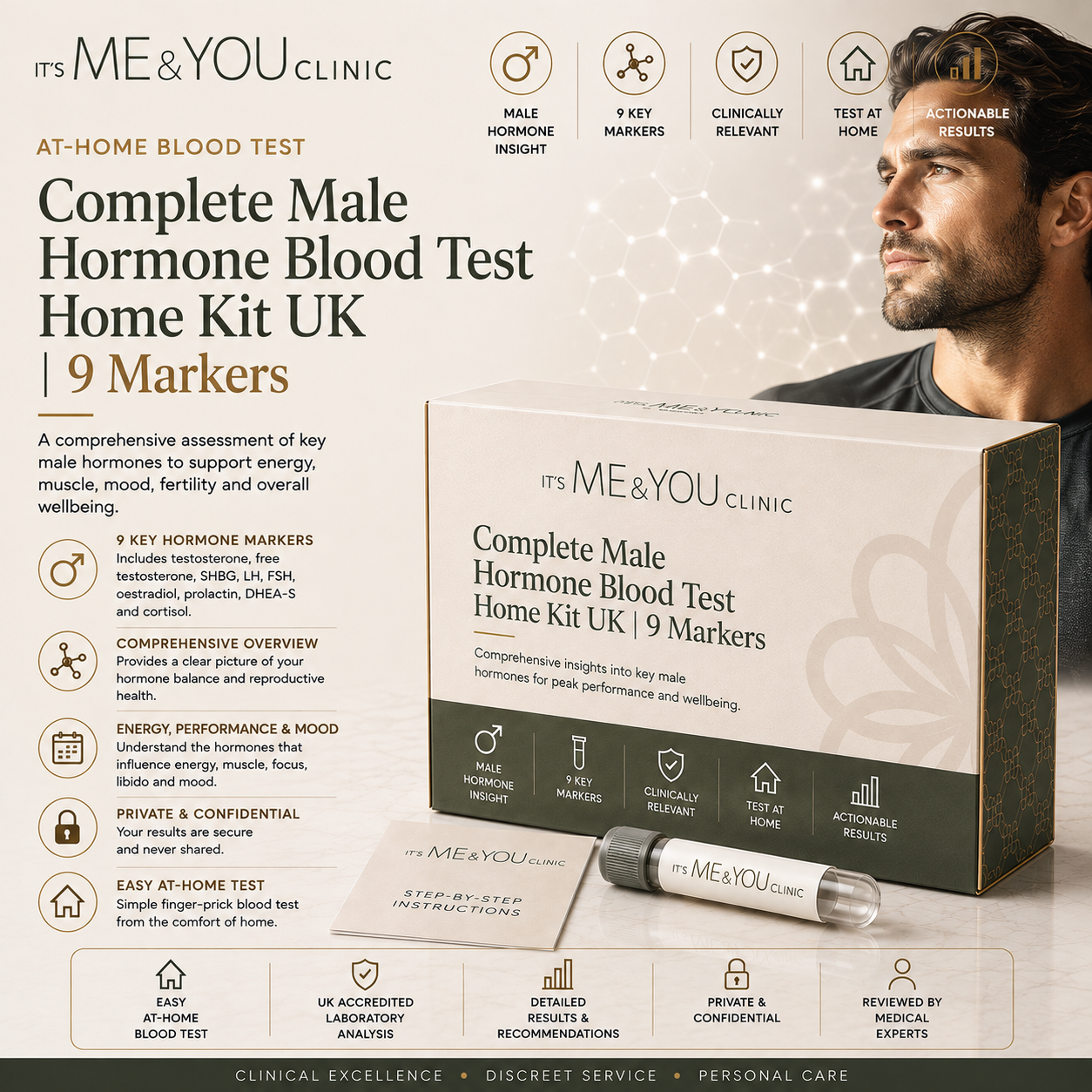
Complete Male Hormone Blood Test Home Kit UK
A nine marker male hormone panel adding adrenal androgen and free androgen index context to the core testosterone and pituitary picture.
This product is designed for a broader androgen question than the eight marker fertility panel. DHEAS adds adrenal context, while the free androgen index provides a separate calculation based on testosterone and SHBG.
When it may be considered
Start with symptoms, risk and the reason for testing
- Persistent low libido or sexual dysfunction
- Reduced strength or unexplained body composition change
- An earlier low, high or inconsistent testosterone result
- Possible pituitary or adrenal androgen concerns
- Monitoring requested by an endocrinologist or urologist
- Using the free androgen index as a diagnosis
- Assessing thyroid function, which is not included in this panel
- Self prescribing testosterone, DHEA or anabolic agents
The report at a glance
How the included markers fit together
A broader androgen dashboard
Four domains within one panel
Not the same as the fertility panel
Why DHEAS and FAI change the purpose
This complete panel is designed for a broader androgen assessment. It adds DHEAS and the free androgen index, while the separate eight marker product includes TSH for thyroid context.
It is calculated from testosterone and SHBG. It should not be treated as a direct measurement or a diagnosis.
Combined hormone patterns
How the report may be organised
Nine marker detail
Result bands and what they may suggest
Luteinising hormone
Luteinising hormone, known as LH, is released by the pituitary gland. In men it stimulates Leydig cells in the testes to produce testosterone.
May occur with pituitary or hypothalamic suppression, acute illness, obesity, opioid use, anabolic steroids, testosterone treatment or other medicines.
Interpret it with testosterone, FSH, prolactin and symptoms.Falls within the laboratory interval.
A normal LH does not exclude a central cause when testosterone is low because it may be inappropriately normal.May indicate that the pituitary is increasing stimulation because the testes are not responding adequately.
Discuss the result with a GP or endocrinology professional.Free androgen index
Free androgen index, known as FAI, is calculated as total testosterone divided by SHBG and multiplied by 100. It estimates androgen availability rather than directly measuring free testosterone.
May reflect lower total testosterone, higher SHBG or both.
Review total testosterone, SHBG, albumin, calculated free testosterone and symptoms.Falls within the reporting laboratory category.
Do not treat a normal FAI as proof that testosterone status is normal.The calculation could not be interpreted reliably, often because testosterone or SHBG was outside the analytical range.
Follow the laboratory recommendation and discuss repeat testing.May reflect higher total testosterone, lower SHBG, testosterone treatment, anabolic steroids or other factors.
Discuss an unexpected result and all hormone products with a clinician.Albumin
Albumin is the principal protein in blood plasma and carries hormones, medicines and other substances. Some testosterone binds loosely to albumin.
Can occur with serious liver disease, kidney protein loss, severe inflammation, malnutrition or critical illness.
Arrange prompt clinical review and follow urgent laboratory advice.May reflect inflammation, liver disease, kidney loss, poor intake, malabsorption or fluid overload.
Discuss wider liver, kidney and inflammatory testing with a GP.Falls within the laboratory reference interval.
Use it as part of free testosterone interpretation where relevant.Most commonly reflects dehydration or concentration of the blood sample.
Review hydration and discuss a persistent result with a clinician.Free testosterone
Free testosterone represents the small fraction of testosterone that is not tightly bound to SHBG or albumin and is available to tissues.
May support reduced androgen availability when compatible symptoms are present. Causes may be testicular, pituitary, hypothalamic, medicine related, metabolic or systemic.
Confirm the finding with clinical assessment and appropriate repeat testing.Falls within the laboratory interval.
Persistent symptoms may still require evaluation for sleep, mood, thyroid, vascular, medicine or other causes.May reflect testosterone treatment, anabolic steroid use, low SHBG, assay factors or less common endocrine conditions.
Discuss an unexpected result with a clinician.Dehydroepiandrosterone sulphate
Dehydroepiandrosterone sulphate, known as DHEAS, is a weak androgen produced mainly by the adrenal cortex. Blood levels are relatively stable through the day and decline with age.
May occur with age, glucocorticoid treatment, reduced adrenal androgen production, pituitary disease or chronic illness.
Review the result with a clinician when symptoms or other hormone abnormalities are present.Falls within the age and sex adjusted laboratory interval.
A normal result does not exclude every adrenal or endocrine condition.May reflect DHEA supplements, assay variation or increased adrenal androgen production. Marked elevations are uncommon.
Stop non prescribed DHEA and discuss an unexplained or substantial elevation with a doctor.Sex hormone binding globulin
Sex hormone binding globulin, known as SHBG, is produced mainly by the liver and binds testosterone in the circulation.
May occur with obesity, insulin resistance, an underactive thyroid, androgen exposure, liver factors or some medicines.
Interpret total testosterone with free testosterone and the wider metabolic context.Falls within the laboratory interval.
Use it with total testosterone and albumin where free testosterone is calculated.May occur with ageing, an overactive thyroid, liver disease, oestrogen exposure, some medicines or low body weight.
Discuss the complete hormone pattern with a clinician.Prolactin
Prolactin is produced by the pituitary gland. When persistently raised in men it can suppress LH and FSH, reduce testosterone and contribute to reduced libido, erectile dysfunction, breast changes or fertility problems.
Often not clinically significant but may occur with dopamine agonist treatment or reduced pituitary function.
Discuss it if other pituitary hormones are abnormal.Falls within the laboratory interval.
Makes clinically significant hyperprolactinaemia less likely.May be temporary or related to medicines, stress, hypothyroidism, kidney disease or pituitary disease.
Mild elevations are often repeated after resting and reviewing medicines.A markedly raised result requires prompt assessment, particularly with headache, visual change, breast discharge or low testosterone.
Follow the urgent laboratory instruction.Total testosterone
Total testosterone measures testosterone circulating in protein bound and unbound forms. It is the usual first laboratory test when testosterone deficiency is suspected.
May occur with primary testicular dysfunction, pituitary or hypothalamic suppression, obesity, acute illness, sleep disruption, medicines, anabolic steroid withdrawal or systemic disease.
Repeat on a separate morning and interpret with LH, FSH, SHBG, free testosterone and prolactin.Falls within the laboratory reference interval.
Persistent symptoms may have another cause and still merit clinical assessment.Most often reflects prescribed testosterone, anabolic steroids, supplements containing hormones or assay factors. Less common endocrine causes are possible.
Discuss an unexpected result and all hormone products with a clinician.Follicle stimulating hormone
Follicle stimulating hormone, known as FSH, is released by the pituitary gland. In men it acts on Sertoli cells and supports sperm production.
May occur with pituitary or hypothalamic suppression, testosterone or anabolic steroid use, acute illness or some medicines.
Interpret it with LH, testosterone, prolactin and fertility history.Falls within the laboratory interval.
A normal FSH does not prove that semen quality is normal.May suggest reduced sperm producing function or broader testicular dysfunction, particularly when semen analysis is abnormal.
Discuss fertility concerns with a GP, urologist or fertility specialist.Preparation protects the value of the result
Before collecting the sample
- Collect in the morning
- Record hormones, DHEA, supplements and anabolic agents
- Rest quietly before collection
- Record fertility priorities and previous hormone results
Collection requirements can vary with the laboratory method, sample stability and clinical purpose. An insufficient, contaminated, delayed or incorrectly labelled sample may not be suitable for analysis.
From order to secure report
How the home testing pathway works
Choose the right question
Review the exact markers, collection method and limitations before ordering.
Receive and register
Use the supplied registration details so the sample is matched to the correct person.
Prepare consistently
Follow timing, fasting, medicine, supplement and activity guidance specific to this test.
Collect at home
Collect the morning finger prick capillary blood sample exactly as instructed.
Return promptly
Use the supplied return materials within the stated stability window.
View results securely
The report is released through the relevant secure digital pathway after quality checks.
Fact checked and medically reviewed
Clinical and editorial oversight
This page was rebuilt from the supplied laboratory specification and checked against the UK medical, regulatory and professional sources listed below. Medical review is attributed to Dr Rimas Geiga, Dr Snieguole Geige, Veronika Matutyte. The wider clinic advisory network is shown in compact form.
 Dr Laura GeigeMedical Director, Senior Practitioner and Skin ExpertAdvisory contributor
 Dr Giedre NarkieneMedical Doctor, Board Certified Dermatologist and Advisory Board MemberAdvisory contributor
 Veronika MatutyteMedical Doctor, Healthcare Management Expert and Advisory Board MemberPage reviewer
 Dr Snieguole GeigeAesthetic Dentist, Medical Doctor and Advisory Board MemberPage reviewer
 Dr Rimas GeigaMedical Doctor, Nutritional Sciences Adviser and Advisory Board MemberPage reviewer
It’s Me & You Clinic in Kingston upon Thames
Doctor led interpretation with local continuity
This broader panel can support a more detailed hormone discussion at the clinic in Kingston upon Thames, with attention to medicines, sleep, weight, fertility priorities and the reason for testing.
Find us
Office 7, Siddeley House, 50 Canbury Park Road
Kingston upon Thames KT2 6LX
Common questions
Clear answers without oversized FAQ cards
How is this different from the eight marker male hormone panel?
This panel includes DHEAS and the free androgen index. It does not include TSH.
What is DHEAS?
DHEAS is an adrenal androgen precursor. It adds adrenal context but does not diagnose an adrenal disorder on its own.
What is the free androgen index?
It is calculated from total testosterone and SHBG. It estimates androgen availability rather than directly measuring free testosterone.
Can the free androgen index diagnose low testosterone?
No. It is one calculated measure and should be interpreted with total testosterone, free testosterone, symptoms and clinical assessment.
Why is prolactin included?
Persistently raised prolactin can suppress reproductive hormone signalling and may require repeat testing or further assessment.
UK medical and laboratory references
Sources used for this page
- NICE assessment of erectile dysfunction and morning testosterone testing
- NHS biochemical investigation of suspected endocrine problems in men
- NHS low sperm count and semen analysis guidance
- NHS prolactin testing information
- NHS SHBG test information
- NHS DHEAS laboratory information
- NHS free androgen index information
- NICE fertility problems assessment and treatment
- UKAS medical laboratory accreditation
- CQC diagnostic and screening services guidance
This page provides general information about selected laboratory markers. It does not provide a diagnosis or personal treatment recommendation. Do not delay care while waiting for a kit or result. Call 999 for a medical emergency. Use NHS 111 or an appropriate clinician for urgent concerns that are not immediately life threatening. Do not change prescribed treatment solely because of a home result.