







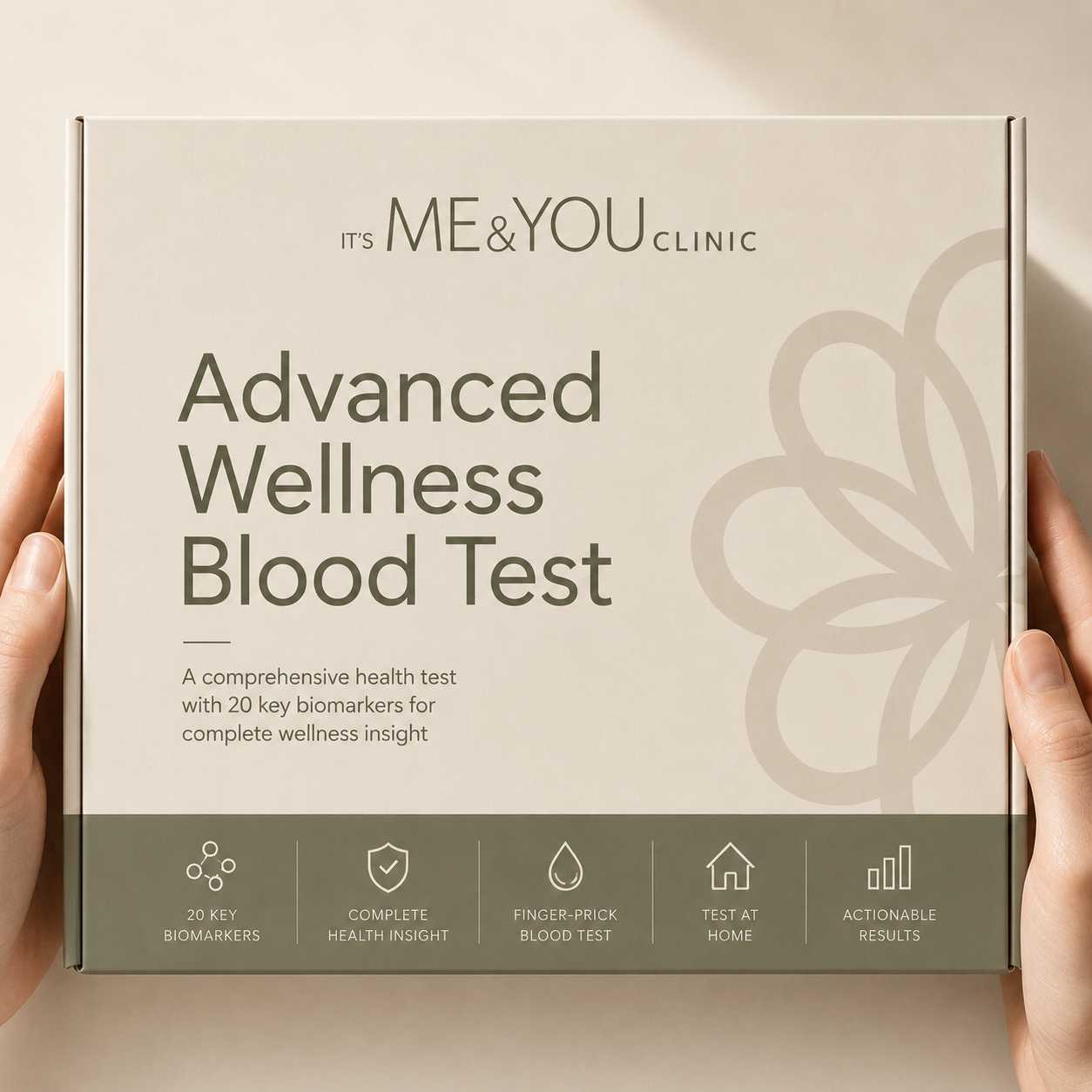




Advanced wellness blood test home kit UK
Advanced Wellness Blood Test Home Kit UK
A broad 20 biomarker home blood panel bringing cardiovascular risk markers, inflammation, liver enzymes, protein status, iron, selected nutrients and hormone context into one structured report.
How to use this product: treat it as four connected laboratory chapters rather than one wellness score. A normal result in one chapter does not cancel an abnormal result elsewhere, and the panel does not replace a symptom led clinical assessment.
One panel, four clinical chapters
A clearer way to read a large wellness profile
Cardiovascular and inflammation
Six markers examine cholesterol distribution, triglycerides and low grade inflammation. They do not replace blood pressure, smoking history, diabetes assessment or a formal cardiovascular risk calculation.
LDL cholesterol, Total cholesterol, HDL cholesterol, Total cholesterol to HDL ratio, Triglycerides, High sensitivity C reactive protein, hsCRPLiver and protein context
ALT and AST provide liver and muscle injury context, while albumin reflects several liver and non liver influences. This is not a complete liver profile and does not stage fibrosis.
Alanine aminotransferase, ALT, Aspartate aminotransferase, AST, AlbuminIron and nutrient status
Six markers cover stored and circulating iron, B12, folate, vitamin D and magnesium. A full blood count, transferrin saturation and other nutritional tests are not included.
Ferritin, Serum iron, Vitamin B12, Folate, vitamin B9, Vitamin D, 25 hydroxyvitamin D, MagnesiumHormone context
Five markers provide selected reproductive and androgen information. Results depend on sex, age, cycle stage, pregnancy possibility, collection time and hormone treatment.
Progesterone, Oestradiol, Total testosterone, Free testosterone, Sex hormone binding globulin, SHBGWhat the panel can provide
A broad laboratory baseline
- A complete six marker lipid and hsCRP chapter
- ALT, AST and albumin for liver, muscle and protein context
- Ferritin, serum iron, vitamin B12, folate, vitamin D and magnesium
- Progesterone, oestradiol, total testosterone, free testosterone and SHBG
- A structured starting point for discussing several areas at once
- A repeatable comparison when preparation and timing remain consistent
- A diagnosis of heart disease, liver disease, anaemia, infertility, PCOS or menopause
- A complete cardiovascular risk score without blood pressure and history
- A complete liver profile or fibrosis assessment
- Iron deficiency anaemia without a full blood count
- Diabetes status because HbA1c and glucose are not included
- Thyroid or kidney function because TSH, creatinine and eGFR are not included
Choose breadth for the right reason
Who may consider this advanced profile
Several health areas need a baseline
Useful when the purpose is broader than cholesterol, vitamins or hormones alone and the person understands that additional testing may follow.
A previous result needs structured comparison
Preparation, fasting, cycle timing, hormone treatment and illness status should be kept as consistent as possible.
A healthcare professional has requested a broad panel
The result can then be interpreted alongside symptoms, examination, family history and medicines.
Do not wait for a postal result
Symptoms that need direct assessment
- Chest pain, severe breathlessness, collapse or symptoms of stroke
- Jaundice, confusion, severe abdominal pain or persistent vomiting
- New walking difficulty, marked weakness or significant neurological symptoms
- Heavy abnormal bleeding, severe pelvic pain or possible pregnancy complication
- Severe muscle weakness, palpitations or symptoms of electrolyte disturbance
- Any rapidly worsening illness or symptom that feels urgent
A narrower test may provide a cleaner answer
Choose the dedicated cholesterol, liver, iron, vitamin, hsCRP or hormone product when only one clinical question needs answering. Large panels can create incidental abnormalities that require repeat testing without explaining symptoms.
Preparation is part of the result
Six decisions before collecting
Important fasting clarification
This product uses a fasting collection pathway
Current UK guidance allows many routine lipid profiles to be measured without fasting. The supplier specification for this particular kit requests a 9 to 12 hour fast, largely because triglycerides and comparison consistency are part of the panel. Follow the kit instructions rather than applying a general rule from another product.
Hydrate normally
Plain water is generally compatible with fasting and may make capillary collection easier. Do not deliberately overhydrate, and do not add anything to the sample tube.
What is absent matters
Tests not included in this profile
Twenty biomarkers, organised by purpose
Colour coded result interpretation
The reporting laboratory’s own units, reference intervals and escalation comments remain authoritative. The explanations below preserve the supplier’s category structure while adding the clinical limits needed for responsible interpretation.
Chapter 01
Cardiovascular and inflammation
LDL cholesterol
LDL cholesterol is one part of a cardiovascular risk assessment. The result should be read with total cholesterol, HDL, triglycerides, the cholesterol to HDL ratio, blood pressure, smoking, diabetes status, family history and any established cardiovascular disease.
A markedly low result is unusual and may reflect intensive lipid lowering treatment, inherited factors, malabsorption, hyperthyroidism or another medical context.
Discuss an unexpected result rather than assuming that lower is always better.A lower LDL result may reflect diet, genetics or lipid lowering treatment and is often favourable within cardiovascular prevention.
Treatment goals depend on personal risk and existing disease.The result is inside the reporting laboratory’s stated interval.
A value in range does not remove risk from smoking, blood pressure, diabetes or family history.The result is above the preferred comparison range but below the highest category.
Review the complete lipid profile and arrange a formal cardiovascular risk assessment.A raised LDL result can reflect inherited or acquired dyslipidaemia.
Discuss secondary causes, overall risk and whether treatment is appropriate.A markedly raised result may indicate substantial cardiovascular risk or possible familial hypercholesterolaemia.
Arrange prompt clinical review and family history assessment.Total cholesterol
Total cholesterol is the combined amount of cholesterol carried in several lipoprotein particles. It should not be interpreted alone because a similar total value can conceal very different LDL, HDL and triglyceride patterns.
A markedly low value is uncommon and may occur with illness, malnutrition, malabsorption, hyperthyroidism or treatment.
Review it with the other markers and clinical context.A lower result can reflect favourable treatment, genetics or reduced cholesterol production.
Use the full profile rather than treating the total value as a diagnosis.The result is within the stated laboratory interval.
Personal targets may be lower when cardiovascular disease or high risk is already present.A mildly raised value requires interpretation of LDL, HDL, triglycerides and non laboratory risk factors.
Arrange risk assessment rather than relying on lifestyle advice alone.A raised total cholesterol result may reflect inherited or acquired lipid disturbance.
Discuss the result with a GP or clinician.A markedly raised result warrants prompt review, especially with a family history of premature cardiovascular disease.
Further assessment and treatment may be required.HDL cholesterol
HDL cholesterol contributes to the distribution pattern within the lipid profile. A higher value does not automatically cancel the effect of raised LDL, smoking, blood pressure, diabetes or established cardiovascular disease.
A lower result may occur with smoking, insulin resistance, raised triglycerides, genetics or some medicines.
Review the complete cardiometabolic pattern.The result is within the laboratory interval.
Continue to interpret it with LDL, triglycerides and the cholesterol to HDL ratio.A higher result may be associated with lifestyle or genetic factors.
Very high HDL is not always protective and should not be used to dismiss other risk factors.Total cholesterol to HDL ratio
The cholesterol to HDL ratio compares total cholesterol with HDL cholesterol. It is one component of risk assessment and should not replace the individual LDL, HDL and triglyceride values.
An unusually low ratio is uncommon and may reflect a very low total cholesterol or a high HDL value.
Review the underlying values rather than interpreting the ratio alone.A lower ratio is generally more favourable within a complete cardiovascular assessment.
Other risk factors remain relevant.The ratio is inside the stated comparison range.
A normal ratio does not exclude cardiovascular disease.A raised ratio suggests an unfavourable cholesterol distribution.
Review LDL, HDL and overall cardiovascular risk.A markedly raised ratio requires prompt review of the underlying lipid values and wider risk factors.
Clinical assessment is appropriate.Triglycerides
Triglycerides are influenced by food, alcohol, glucose regulation, weight, genetics and medicines. Very high concentrations may carry pancreatitis risk as well as cardiometabolic implications.
A markedly low result is unusual and may reflect low intake, malabsorption, hyperthyroidism or another condition.
Discuss an unexpected result with a clinician.A lower result can occur with dietary patterns or genetics and is often not concerning by itself.
Interpret it with the wider panel.The result is inside the stated interval.
Maintain consistent preparation when comparing future results.The result may be influenced by a recent meal, alcohol, insulin resistance or medicines.
Review fasting status and consider a repeat under controlled conditions.A raised result can occur with diabetes, alcohol use, kidney disease, weight gain, medicines or inherited lipid disorders.
Discuss secondary causes and cardiovascular risk.A markedly raised concentration can require urgent clinical assessment because severe hypertriglyceridaemia may increase pancreatitis risk.
Follow the laboratory escalation advice promptly.High sensitivity C reactive protein, hsCRP
hsCRP measures the same inflammatory protein as standard CRP using a method designed to detect lower concentrations. It is non specific and must not be used as a substitute for traditional cardiovascular risk factors.
The value is within the reporting laboratory’s lower category.
This does not rule out cardiovascular disease or every inflammatory condition.A raised result may reflect infection, injury, inflammatory disease, smoking, obesity or another acute or chronic cause.
Do not interpret it as cardiovascular risk during active illness. Repeat testing may be needed after recovery.Chapter 02
Liver and protein context
Alanine aminotransferase, ALT
ALT is found mainly in liver cells. A raised value can indicate liver cell injury, but the height of the result does not identify the cause or reliably stage fibrosis.
A lower ALT result is usually not clinically significant, although nutrition and individual factors can influence it.
Interpret it with symptoms and the rest of the panel.The result is inside the laboratory interval.
Normal ALT does not exclude fatty liver, fibrosis, cirrhosis or every liver condition.A raised result may occur with metabolic liver disease, alcohol, viral hepatitis, medicines or another cause of liver injury.
Review alcohol, medicines, weight, metabolic risk and whether wider testing is required.A markedly raised result may indicate substantial liver cell injury.
Arrange urgent clinical review, especially with jaundice, severe abdominal pain, vomiting, confusion or feeling very unwell.Aspartate aminotransferase, AST
AST is present in liver, heart and skeletal muscle. A raised result therefore requires context from ALT, exercise, muscle injury, medicines, alcohol and symptoms.
A markedly low result is uncommon and rarely diagnostic by itself.
Review it only in the wider clinical context.A lower AST value is usually not concerning in isolation.
Persistent symptoms still require assessment.The result is inside the laboratory interval.
Normal AST does not exclude liver disease.A raised result may reflect liver injury, strenuous exercise, muscle damage, alcohol or medicines.
Review it with ALT and consider muscle related testing where appropriate.A markedly raised result warrants urgent clinical review.
Symptoms and the full liver and muscle context determine the next step.Albumin
Albumin is made by the liver and helps maintain fluid balance and transport substances in the blood. It is a non specific marker influenced by inflammation, kidney protein loss, nutrition, hydration and liver synthesis.
A markedly low result can occur with serious liver disease, kidney protein loss, severe inflammation, malnutrition or critical illness.
Arrange prompt clinical review.A lower value may reflect inflammation, liver disease, kidney loss, malabsorption, poor intake or fluid overload.
Further assessment may include kidney, liver, inflammatory and nutritional tests.The result is within the stated interval.
A normal value does not prove that the liver and kidneys are healthy.A raised value is most often associated with dehydration or sample concentration.
Review hydration and repeat if advised.A markedly raised value is unusual and may indicate significant dehydration or an analytical issue.
Follow the laboratory advice.Chapter 03
Iron and nutrient status
Ferritin
Ferritin reflects stored iron when inflammation is absent. It is also an acute phase protein, so a raised value can occur with infection, inflammation, liver disease, alcohol use, kidney disease or other conditions without iron overload.
A lower ferritin result is consistent with depleted iron stores and can occur with blood loss, reduced intake or impaired absorption.
A full blood count and investigation of the cause may be needed.The value is inside the laboratory interval.
Inflammation can raise ferritin and obscure iron deficiency, so symptoms and hsCRP context matter.A raised result may reflect inflammation, liver disease, alcohol, metabolic factors, supplements or iron overload.
Do not diagnose haemochromatosis from ferritin alone. Transferrin saturation and further review may be required.Serum iron
Serum iron is the amount of iron circulating at the time of collection. It changes through the day and with meals, inflammation and supplements, so it is weaker than ferritin and a complete iron profile for diagnosing iron deficiency or overload.
A lower result can occur with iron deficiency, inflammation, blood loss or normal biological variation.
Interpret it with ferritin and, where needed, a full blood count and transferrin saturation.The result is inside the laboratory interval.
A normal serum iron does not exclude depleted iron stores.A raised result may reflect supplements, recent intake, iron overload, liver disease or haemolysis.
Repeat and wider iron studies may be needed before drawing conclusions.Vitamin B12
Vitamin B12 supports neurological function, DNA synthesis and red blood cell production. Total B12 is useful, but no single concentration perfectly confirms or excludes deficiency.
A lower result can occur with inadequate intake, pernicious anaemia, gastrointestinal disease, medicines or other absorption problems.
Prompt review is important with pins and needles, walking difficulty, memory change or marked weakness.The result is within the laboratory interval.
Persistent compatible symptoms may justify further assessment because total B12 is not a perfect test.A raised result commonly reflects supplements or injections, but may also occur with liver, kidney, inflammatory or blood disorders.
Review treatment and discuss an unexpected persistent elevation.Folate, vitamin B9
Folate supports cell division and red blood cell production and is important before and during early pregnancy. Serum folate can be influenced by recent diet and supplements.
A markedly low result can occur with inadequate intake, malabsorption, increased requirements or medicine effects.
Arrange prompt review and assess vitamin B12 before treating folate deficiency in isolation.A lower result can support folate deficiency when interpreted with diet, symptoms and a full blood count.
Discuss replacement and the underlying cause with a clinician.The value is inside the laboratory interval.
Pregnancy related folic acid recommendations still apply regardless of this result.A raised value is commonly influenced by supplements or fortified foods.
Review folic acid intake and consider the vitamin B12 result.A markedly raised result should be interpreted with prescribed and non prescribed supplements.
Do not stop prescribed pregnancy supplementation without advice.Vitamin D, 25 hydroxyvitamin D
Vitamin D helps regulate calcium and phosphate and supports bones and muscles. Concentrations are influenced by sunlight exposure, skin pigmentation, diet, supplements, absorption and medical conditions.
The lowest category indicates substantial vitamin D depletion.
Discuss the result promptly so the cause, symptoms and treatment can be assessed.A deficient result can occur with limited sunlight exposure, darker skin, covering most skin, malabsorption or other risk factors.
Clinical review is appropriate, particularly with bone pain or muscle weakness.The result is below the preferred level but above the deficiency category.
Review risk factors and supplement guidance.The value is within an adequate reporting category.
Continue a balanced approach to sunlight, diet and appropriate UK supplement advice.A raised value is most often related to excessive supplementation, although other causes may need assessment.
Stop additional non prescribed high dose vitamin D and obtain prompt medical advice. Do not stop prescribed treatment without advice.Magnesium
Magnesium contributes to nerve, muscle and cardiac electrical function. Blood magnesium is regulated by intestinal absorption and kidney excretion and may not reflect every intracellular magnesium issue.
A markedly low concentration can affect cardiac rhythm and may occur with gastrointestinal loss, medicines or kidney wasting.
Arrange urgent clinical review.A lower result may be associated with diarrhoea, malabsorption, alcohol, proton pump inhibitors, diuretics or other causes.
Review medicines, kidney function, potassium and calcium where appropriate.The result is within the stated interval.
Persistent symptoms still require clinical assessment.A raised result is uncommon with normal kidney function and may reflect supplements, kidney impairment or medicine exposure.
Discuss the result and supplement use.A markedly raised value can affect cardiac and neuromuscular function.
Obtain urgent medical review.Chapter 04
Hormone context
Progesterone
Progesterone rises after ovulation and reaches its highest concentration in the mid luteal phase. Its meaning depends heavily on the reason for testing, cycle length, expected next period, pregnancy status and hormone treatment.
A lower value may be entirely expected in the follicular phase or after menopause. When ovulation is the question, poor timing can make an ovulatory cycle appear low.
Collect approximately seven days before the expected next period rather than using a fixed day for every cycle.The result is inside the laboratory’s phase specific interval.
A value in range must still match the recorded cycle stage and clinical question.A raised value may reflect the luteal phase, pregnancy or hormone treatment and less commonly another ovarian or adrenal context.
Review cycle day, pregnancy possibility and medicines.Oestradiol
Oestradiol varies substantially across the menstrual cycle and is also affected by pregnancy, menopause, contraception, HRT and fertility treatment. A single result is not a complete fertility or menopause assessment.
A lower result may occur in the early follicular phase, menopause, hypothalamic suppression, ovarian insufficiency or during treatment.
Interpret it with age, cycle stage, symptoms, medicines and other hormones.The result is within the relevant laboratory interval for the recorded context.
A normal result does not establish normal fertility or exclude every endocrine condition.A raised value may occur around ovulation, during pregnancy, with hormone treatment or in less common ovarian or adrenal conditions.
Review timing, treatment and symptoms.Total testosterone
Total testosterone measures both protein bound and unbound hormone. Its interpretation depends on sex, age, collection time, symptoms, SHBG, medicines and hormone exposure.
In men, a lower morning result can occur with illness, obesity, sleep disruption, medicines, pituitary or testicular conditions. In women, low total testosterone is often difficult to interpret alone.
Men usually need a repeat controlled morning result and wider hormone assessment before diagnosis.The result is within the laboratory interval.
A normal total testosterone does not guarantee that free testosterone is normal or that symptoms have a hormonal cause.A raised result may reflect prescribed testosterone, anabolic agents, gel contamination, supplements, PCOS or less common ovarian, adrenal or testicular conditions.
Discuss an unexpected result and all hormone products with a clinician.Free testosterone
Free testosterone estimates the fraction not strongly bound to proteins. The result depends on the method and should be considered with total testosterone, SHBG, sex, symptoms and collection timing.
A lower result can reflect lower total testosterone, higher SHBG or both.
In men, confirm an abnormal result with controlled morning testing and clinical assessment.The value is inside the laboratory interval.
Persistent symptoms may have another cause and still require assessment.A raised result can reflect higher total testosterone, lower SHBG, hormone treatment, anabolic agents, PCOS or another endocrine cause.
Review medicines, supplements, symptoms and the full hormone pattern.Sex hormone binding globulin, SHBG
SHBG binds testosterone and oestradiol and changes how total hormone results relate to estimated free hormone. It is influenced by weight, insulin resistance, thyroid status, liver disease, pregnancy, ageing and medicines.
A lower result may occur with obesity, insulin resistance, hypothyroidism, glucocorticoids, androgens or progestogens.
Interpret total and free testosterone together rather than diagnosing a condition from SHBG alone.The result is within the stated interval.
The clinical question and hormone results remain important.A raised value may occur with pregnancy, oestrogen exposure, hyperthyroidism, liver disease, lower body weight or ageing.
Review treatment and wider health context.From order to secure report
How the home testing pathway works
Confirm the panel fits
Review all 20 markers, important omissions and whether a narrower or direct clinical assessment is more appropriate.
Register the kit
Use the supplied identifiers so the sample and secure report are matched correctly.
Prepare deliberately
Fast for the stated period, wait after acute illness and record medicines, supplements, cycle day and hormone exposure.
Collect capillary blood
Warm the hands and fill the microtainer to the required line without squeezing excessively.
Return promptly
Use the supplied packaging and dispatch timing so sample stability is protected.
Read chapter by chapter
Separate cardiovascular, liver, nutrient and hormone findings before deciding which result needs follow up.
Medical and editorial governance
Clinical oversight and advisory contributors
This page has been rebuilt from the supplier specification supplied by the user and checked against the current UK medical and pathology references listed below. The exact final version should complete the clinic’s documented medical approval process before publication.
 Dr Laura GeigeMedical Director, Senior Practitioner and Skin ExpertPage reviewer
 Dr Giedre NarkieneMedical Doctor, Board Certified Dermatologist and Advisory Board MemberAdvisory contributor
 Veronika MatutyteMedical Doctor, Healthcare Management Expert and Advisory Board MemberPage reviewer
 Dr Snieguole GeigeAesthetic Dentist, Medical Doctor and Advisory Board MemberAdvisory contributor
 Dr Rimas GeigaMedical Doctor, Nutritional Sciences Adviser and Advisory Board MemberPage reviewer
It’s Me & You Clinic in Kingston upon Thames
Local clinical context for a broad home report
A 20 marker panel can produce several unrelated findings. The clinic provides a private setting for discussing which result is likely to matter, what may be explained by timing or treatment, and whether repeat testing, a GP review or a more focused panel is appropriate.
Clinic details
Office 7, Siddeley House
50 Canbury Park Road
Kingston upon Thames KT2 6LX
Questions before ordering
Advanced Wellness blood test FAQs
What does the Advanced Wellness blood test measure?
It reports 20 biomarkers across lipids and hsCRP, liver enzymes and albumin, iron and nutrients, and selected reproductive and androgen hormones.
Do I need to fast?
For this specific product, follow the supplier instruction to fast for 9 to 12 hours, drinking plain water only. Many routine lipid profiles can be non fasting, but this kit uses a fasting approach for triglyceride and comparison consistency.
Should I test when I have a cold or infection?
No when the hsCRP result is intended for cardiovascular context. Wait until the acute illness or inflammatory episode has settled. The supplier advises waiting at least one week after illness or infection.
When should progesterone be tested?
When the question is whether ovulation occurred, collect about seven days before the expected next period. Day 21 only fits a regular 28 day cycle.
Does the panel diagnose heart disease?
No. Lipids and hsCRP provide risk related laboratory information but do not diagnose blocked arteries, a heart attack or stroke.
Does it include a complete liver function test?
No. ALT, AST and albumin are included, but bilirubin, ALP, GGT, total protein, platelets and clotting are not.
Can it diagnose iron deficiency anaemia?
No. Ferritin and serum iron are included, but a full blood count and complete iron studies are not.
Can it diagnose PCOS, infertility or menopause?
No. Hormone results require clinical history and often additional tests. A single cycle dependent result cannot establish these diagnoses.
Does it include thyroid, diabetes or kidney markers?
No. TSH, free T4, HbA1c, glucose, creatinine and eGFR are not included.
Should I stop supplements or medicines before testing?
Do not stop prescribed treatment independently. Record vitamins, iron, magnesium, hormone therapy, anabolic agents, lipid medicines and all other relevant products.
Current UK medical and pathology references
Sources used to check this page
- NHS: High cholesterol testing and fasting
- NHS: Understanding cholesterol levels
- NICE: Cardiovascular disease risk assessment and lipid modification
- Cambridge University Hospitals: High sensitivity CRP
- NHS Specialist Pharmacy Service: Interpreting liver blood tests
- Gloucestershire Hospitals: Ferritin assay
- NHS: Vitamin B12 or folate deficiency anaemia
- NHS: B vitamins and folic acid
- NHS: Vitamin D
- Gloucestershire Hospitals: Magnesium
- University Hospitals North Midlands: Progesterone timing
- Gloucestershire Hospitals: Sex hormone binding globulin
Home testing provides laboratory information, not a diagnosis or personal treatment plan. Do not delay urgent care while waiting for a kit or result. Call 999 for a medical emergency. Use NHS 111 or an appropriate clinician for urgent concerns that are not immediately life threatening. Do not start, stop or alter prescribed treatment solely because of a home result.